Product discovery · PRD · UX design
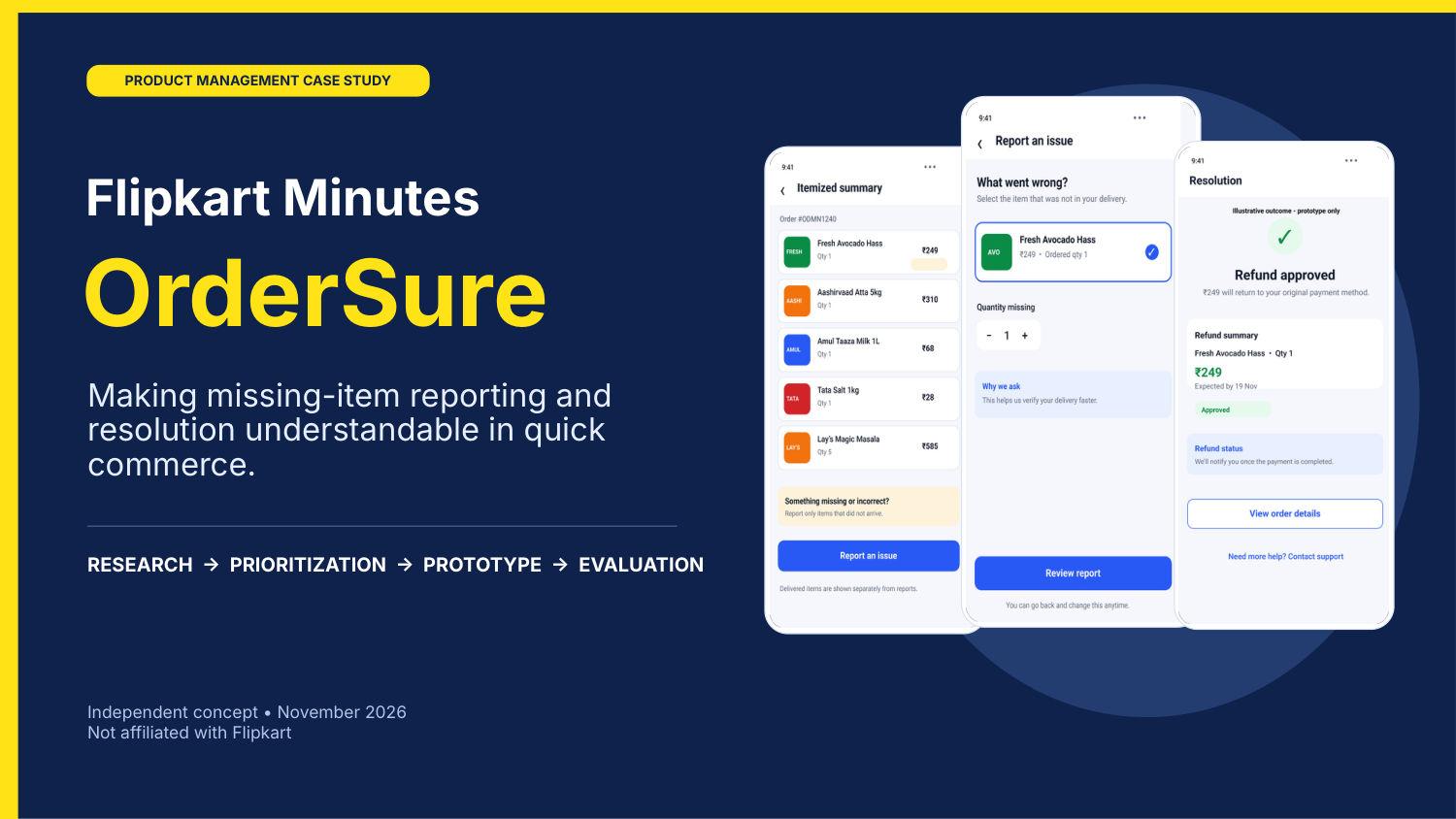
Flipkart Minutes — OrderSure
Making missing-item reporting and resolution understandable in quick commerce: research, prioritisation, a seven-screen prototype and a validation plan.
- Status
- Independent concept · seven-screen prototype
- My role
- Research synthesis, prioritisation, product definition and prototype screens.
Independent concept, November 2026. Not affiliated with Flipkart; no access to Flipkart internal data.
In two minutes
- Problem: when a five-item order arrives with four items, it isn't clear how to report exactly what's missing or what happens next.
- Decision: an item-level report plus a persistent case tracker, not proactive alerts or automatic refunds.
- Key principle: a case is not a refund. Reported, reviewing and resolved are separate states.
- Unproven: research is secondary only (no interviews or survey). Targets and the ₹249 example are simulated.
Built
- Seven-screen Figma prototype: four-step reporting flow and three resolution screens
- Decision workflow and trust-design principles
Proposed
- Moderated pilot of 8–12 task tests against the documented support route
- Production KPIs: support contacts per affected order and issue recontacts
Not claimed
- Interviews, survey data or observation of the current Minutes interface
- Validated retention lift or support-cost savings
- Any Flipkart affiliation or internal data
Trust becomes critical as quick commerce scales
ResearchFlipkart Minutes is growing quickly. Post-delivery exceptions deserve the same design discipline as the purchase journey.
- 4×
- Year-on-year growth
- ~1,200
- Micro-fulfilment centres
- 150+
- Cities served
- ~60%
- Customers who return
Company-reported figures from Flipkart Stories (11 Sep 2026). They give context only; no causal claim is made about complaints.
- Strategic question: when a five-item order arrives with four, how clearly can the customer report what went wrong and follow the outcome?
- Business hypothesis: better issue visibility could reduce repeat contacts and protect repeat intent. Impact is not measured.
Three signals, one opportunity
ResearchSynthesis: the opportunity isn't “create customer support”. It is making affected items, case status and next steps explicit at the order level.
Signal 1
Sep 2026 customer report: two missing items worth ₹553, and a chat connection error when seeking support.
Signal 2
Jul 2026 public discussion: a reduced quantity and an unexpected delivery fee on a Minutes order.
Signal 3
Documented support route: Account → Orders → select order → Help → Chat with us. An official route exists; Minutes-specific item-level UX needs validation.
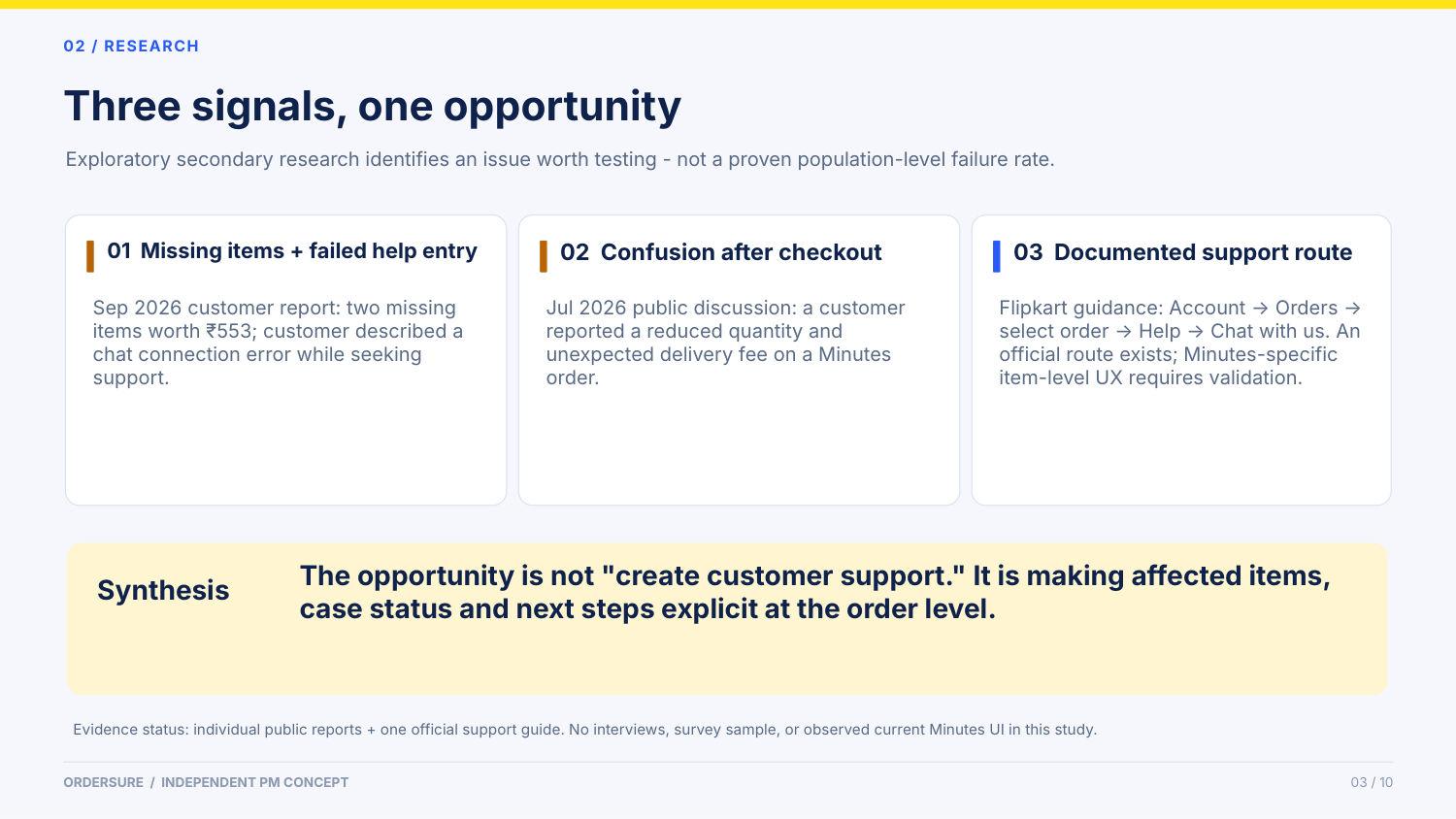
Boundary. Evidence is individual public reports plus one official support guide. No interviews, survey sample or observation of the current Minutes interface.
The customer and the moment
HypothesisPrimary segment: time-constrained shoppers receiving multi-item quick-commerce deliveries.
Illustrative scenario: five items ordered, four received, ₹1,240 paid, a ₹249 avocado missing, and the order marked delivered.
Job to be done: help me report what did not arrive and know exactly what happens next.
- Constraint: refund approval can't be assumed. Verification and support remain necessary.
- Functional need: select the exact item and quantity without reconstructing the whole order.
- Emotional need: understand whether a claim is received, verified or resolved.
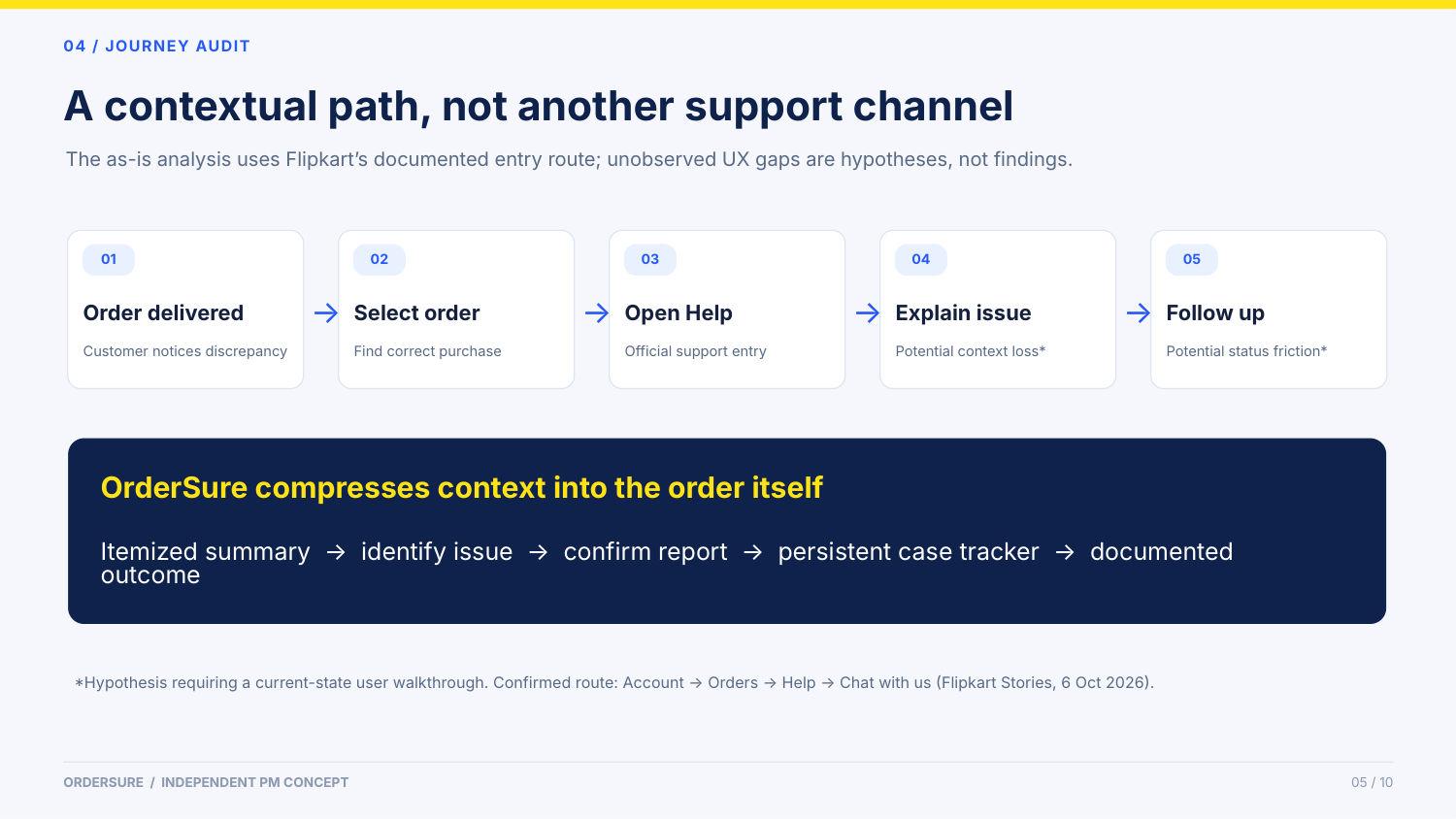
A contextual path, not another support channel
HypothesisThe as-is audit uses Flipkart's documented entry route. The unobserved gaps (context loss after “Help”, status friction on follow-up) are hypotheses, not findings.
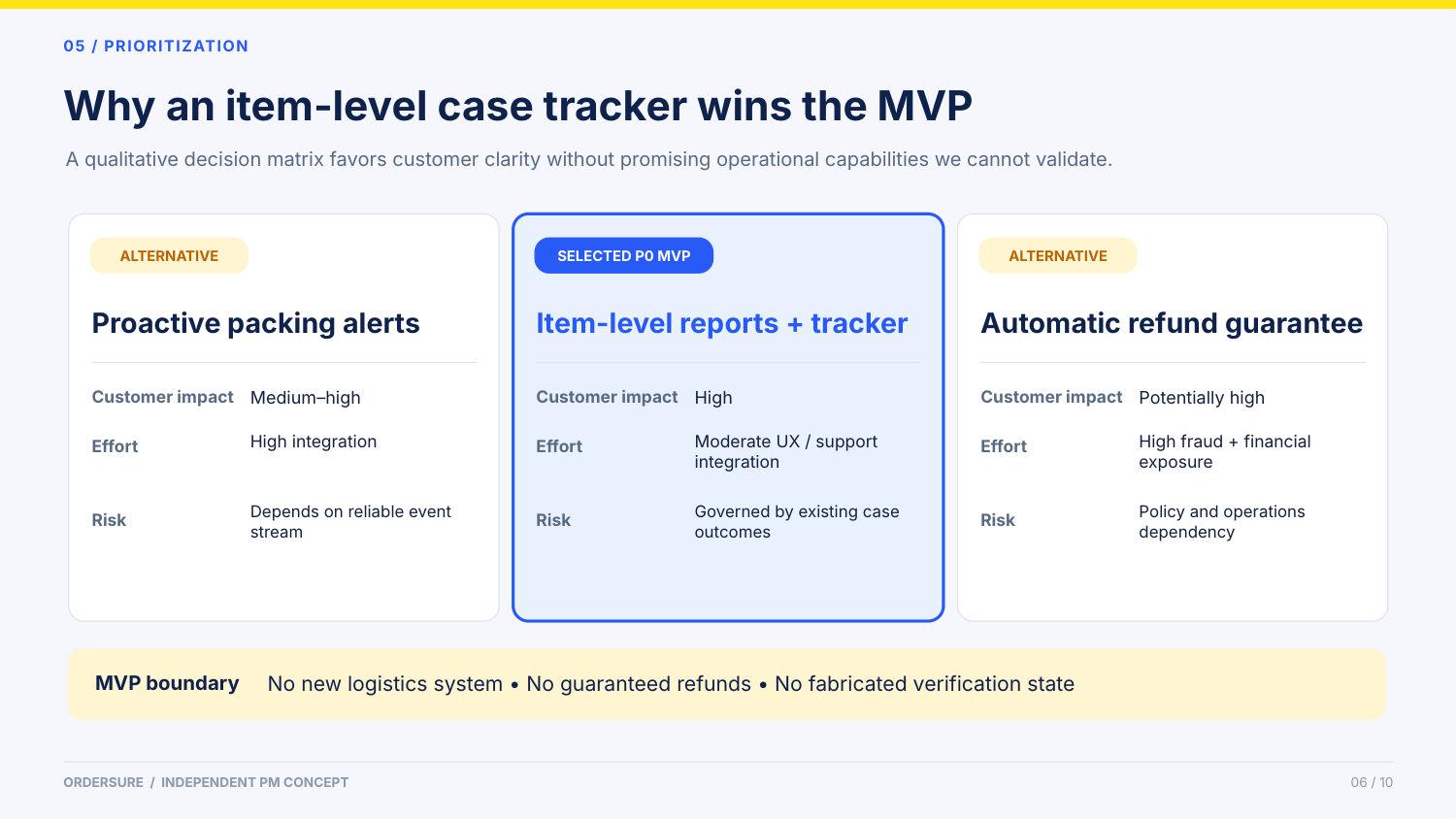
Why an item-level case tracker wins the MVP
ProposalMVP boundary: no new logistics system, no guaranteed refunds, no fabricated verification state.
Alternative· Not chosen
Proactive packing alerts. Medium–high customer impact, but high integration effort and a dependency on a reliable event stream.
P0 MVP· Selected
Item-level reports plus a tracker. High customer impact, moderate UX and support integration, governed by existing case outcomes.
Alternative· Not chosen
Automatic refund guarantee. Potentially high impact, but high fraud and financial exposure and a policy dependency.
The resolution system behind seven screens
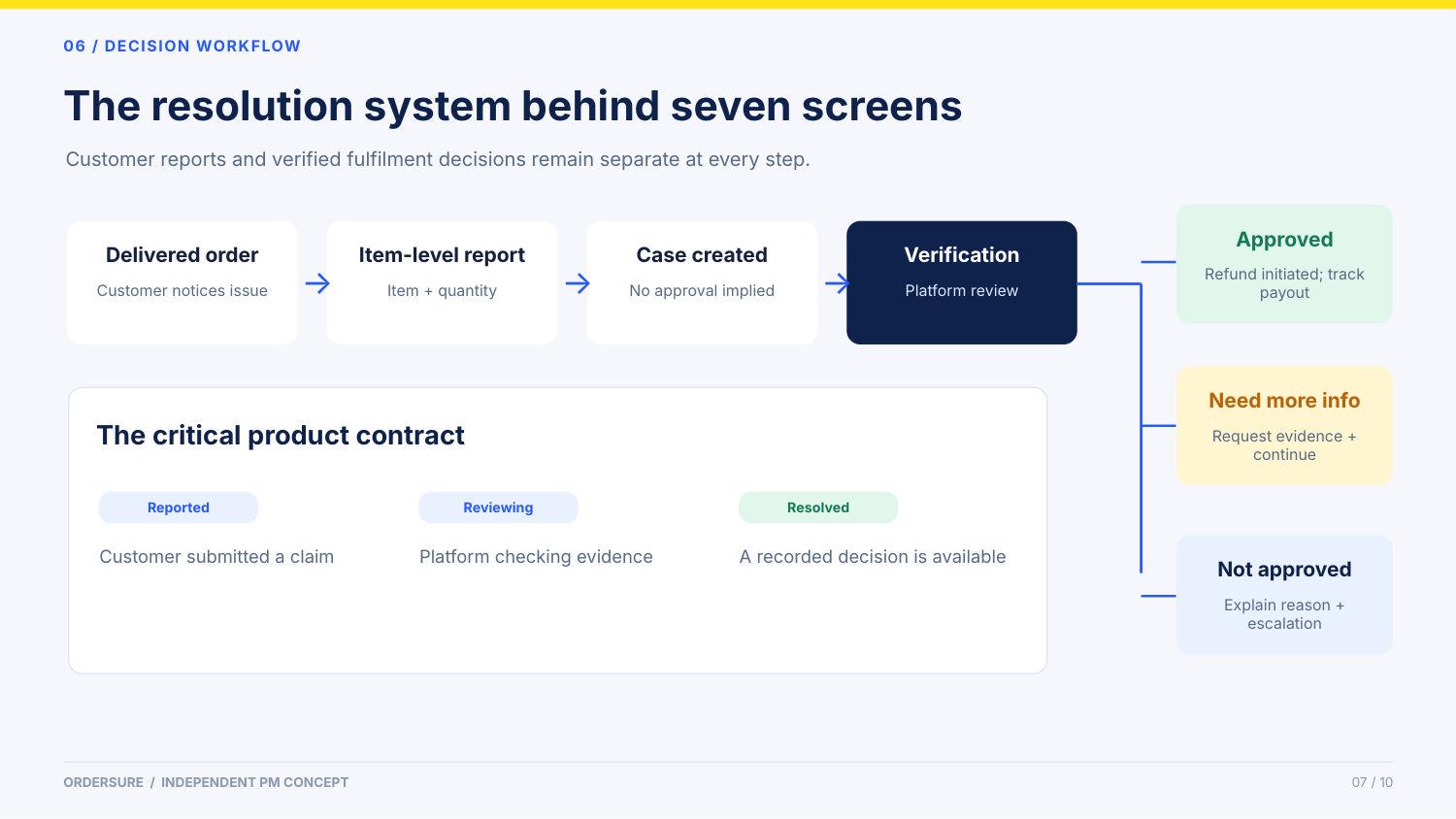
ProposalCustomer reports and verified fulfilment decisions stay separate at every step.
A delivered order leads to an item-level report, a created case (with no approval implied) and a platform review. Review ends in one of three outcomes: approved (refund initiated, payout trackable), need more information, or not approved (reason and escalation).
The product contract has three visible states: reported (the customer submitted a claim), reviewing (the platform is checking evidence) and resolved (a recorded decision exists).
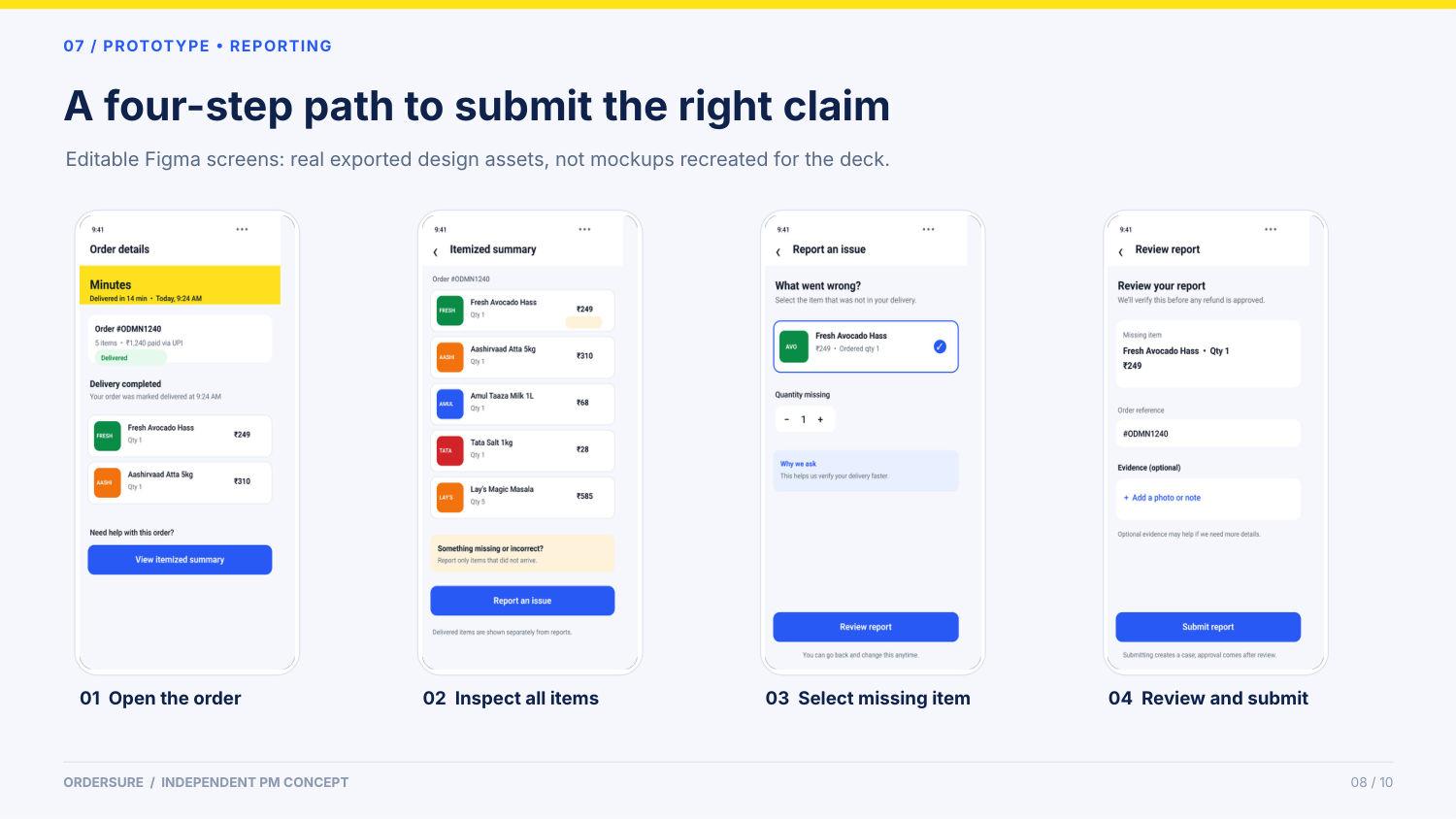
Prototype: report the right claim, then see where it stands
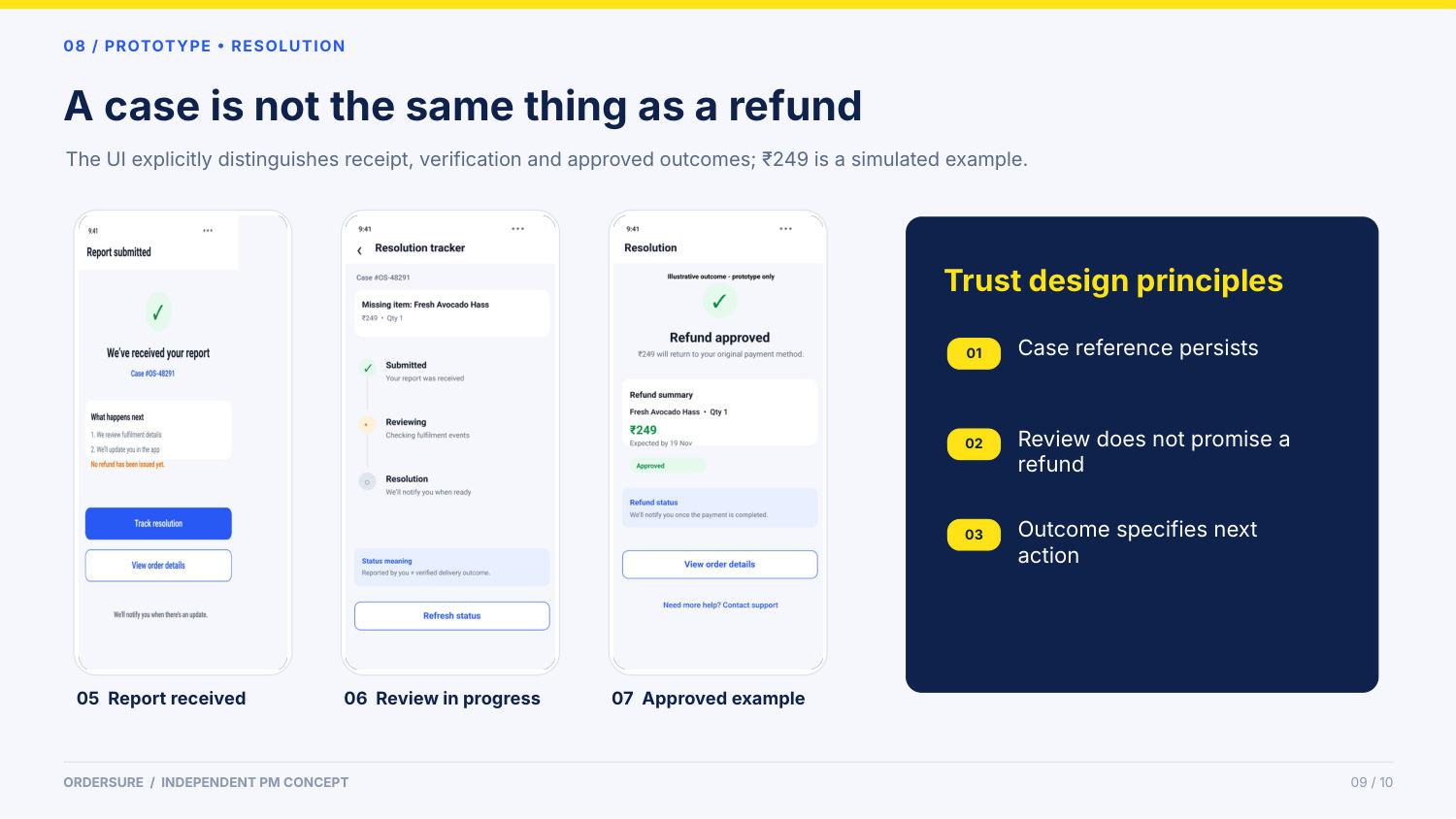
ProposalReporting takes four steps: open the order, inspect all items, select the missing item, review and submit. Resolution takes three screens: report received, review in progress, and an approved example.
- The case reference persists.
- Review never promises a refund.
- Every outcome states the next action.
Boundary. These are prototype screens. They are not the shipped Flipkart interface.
How value would be established
TargetTest plans and targets, not observed performance.
- Usability: successful report with correct case-status understanding; median time and steps; share who distinguish “reviewing” from “approved”; post-task confidence (1–5).
- Pilot: 8–12 moderated task tests against the documented support route.
- Proposed targets: at least 80% completion and 90% status comprehension.
- Production KPIs: support contacts per affected order and issue recontacts.
- Guardrails: incorrect claims, resolution cost and access to escalation.
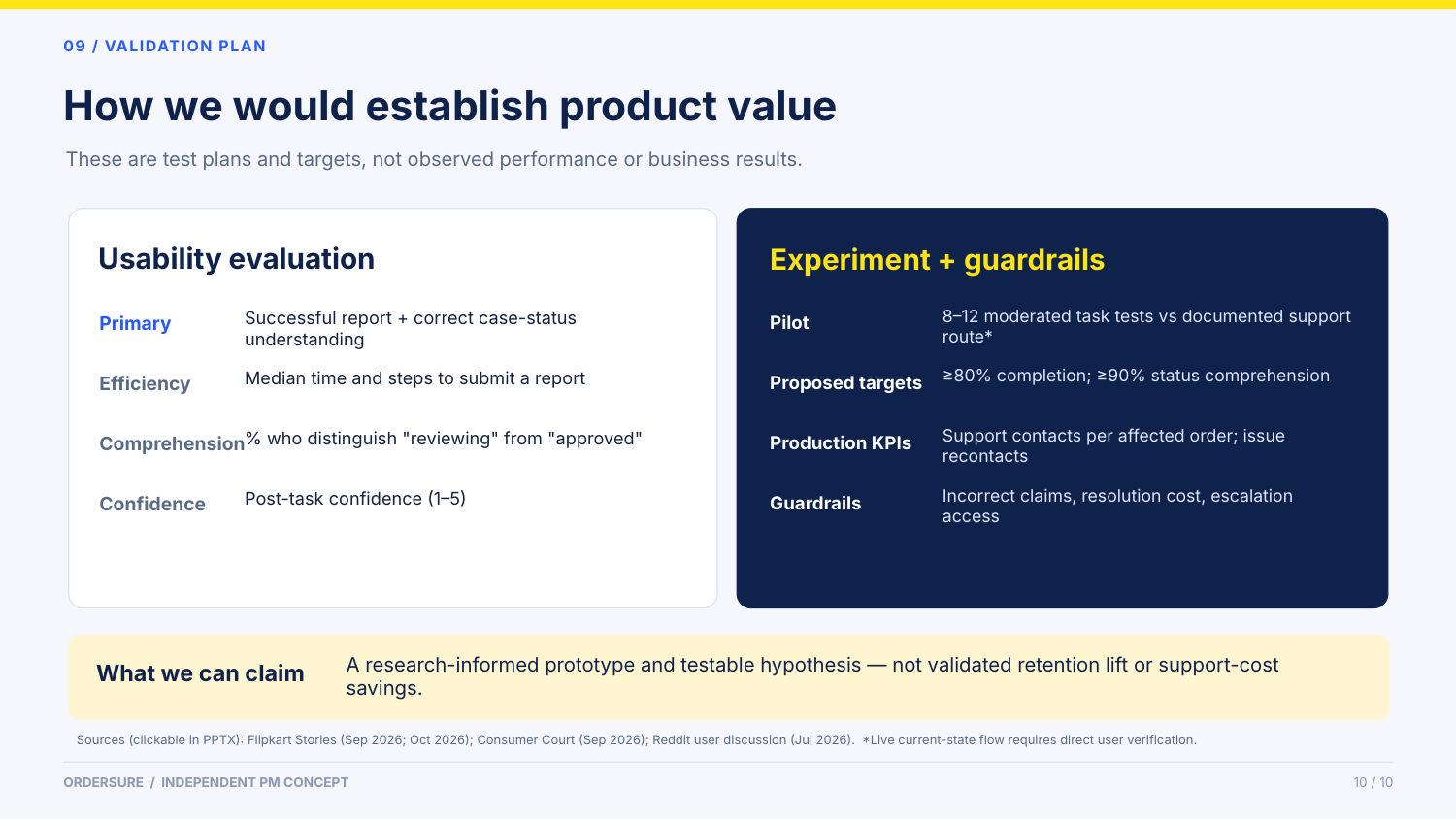
Boundary. What can be claimed: a research-informed prototype and a testable hypothesis, not validated retention lift or support-cost savings.
Sources
- Flipkart Stories, Sep 2026 and Oct 2026: cited in the PDF
- Consumer Court (Sep 2026) and a Reddit user discussion (Jul 2026): cited in the PDF