Product discovery · AI prototyping · Decision systems
Myntra AI OccasionReady
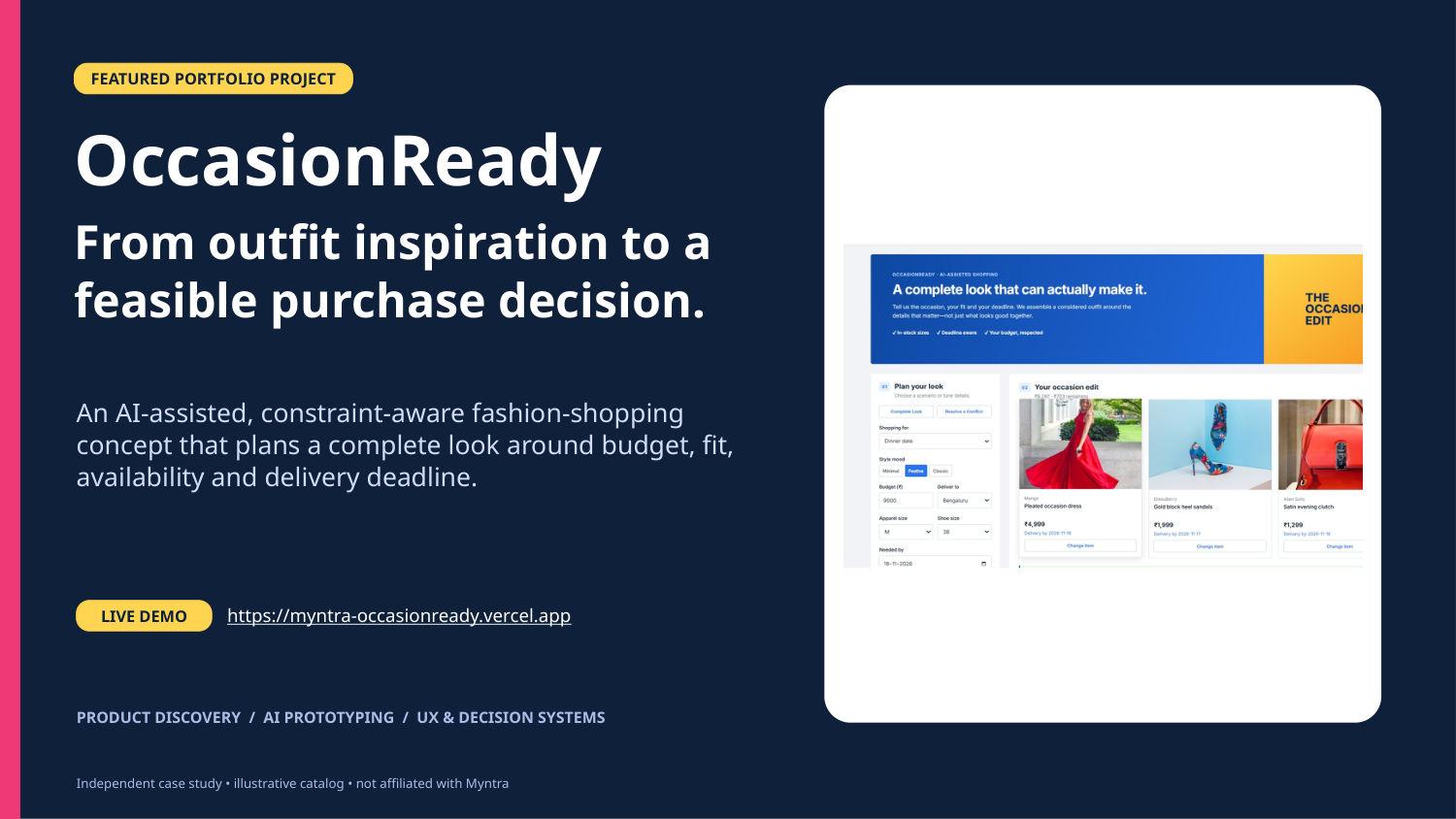
From outfit inspiration to a feasible purchase decision: an AI-assisted, constraint-aware concept that plans a complete look around budget, fit, availability and delivery deadline.
- Status
- Independent concept · working demo on an illustrative catalog
- My role
- Product definition, UX flow and a working prototype.
Independent case study. Not affiliated with Myntra; the demo does not use Myntra data.
In two minutes
- Problem: a complete look fails if even one essential item doesn't fit the budget, the size or the delivery date.
- Decision: build a constraint-aware complete-look planner instead of smarter search or a stylist-only chatbot.
- Built: a working demo where AI drafts the request, the shopper confirms it, and deterministic rules decide eligibility.
- Unproven: no usability study or conversion result exists. The success metrics are targets.
Built
- Natural-language intent parsing
- Mandatory preference review before planning
- Deterministic checks for budget, size and delivery date
- Item substitution and a shared bag
- Public deployment on Vercel
Proposed
- Five task-based usability sessions
- Event-level funnel instrumentation
- Stock and ETA accuracy partnership
- A/B comparison against baseline shopping
- Contribution-margin and returns analysis
Not claimed
- Live Myntra catalog, pricing or inventory
- Payments or real orders
- Actual stock or courier delivery times
- Measured retention or conversion lift
- Independent user-study results
The opportunity is narrower than “AI styling”
ResearchDiscovery is already AI-assisted. A shoppable ensemble must also be feasible.
According to the source deck, Myntra already offers natural-language discovery and styling through MyFashionGPT, MyStylist and Maya.
The shopper's next question is different: will every item fit, stay inside my total budget and arrive before the event?
- Not: “generate a nice outfit”.
- Instead: “assemble an eligible outfit I can confidently put in my bag”.
Boundary. Historical Myntra reports of improved AI-assisted purchase behaviour are context, not OccasionReady test results.
The problem is constraint conflict, not a lack of ideas
HypothesisIllustrative scenario: a wedding in Bengaluru, ₹6,000 total budget, apparel size M, shoe size 38, arriving by 19 November.
A look can coordinate visually and still fail on eligibility (one size or SKU unavailable) or feasibility (combined price or delivery date breaks the plan).
Boundary. Customer interviews and frequency estimates are not claimed. The scenario is a plausible shopping task, not research.
Who the MVP is for
HypothesisPlanned purchases, not casual browsing.
Job to be done: when an event has a deadline, help me assemble a compatible, eligible look without repeated manual cross-checking.
Primary
Occasion-led buyer: wedding, interview, dinner, festival. Needs a date-specific full look inside one combined budget.
Secondary
Budget-constrained shopper: student, early-career, first-job buyer. Wants the real basket price before falling for an outfit.
Later
Everyday discovery shopper: open-ended browsing, where deadline certainty may matter less.
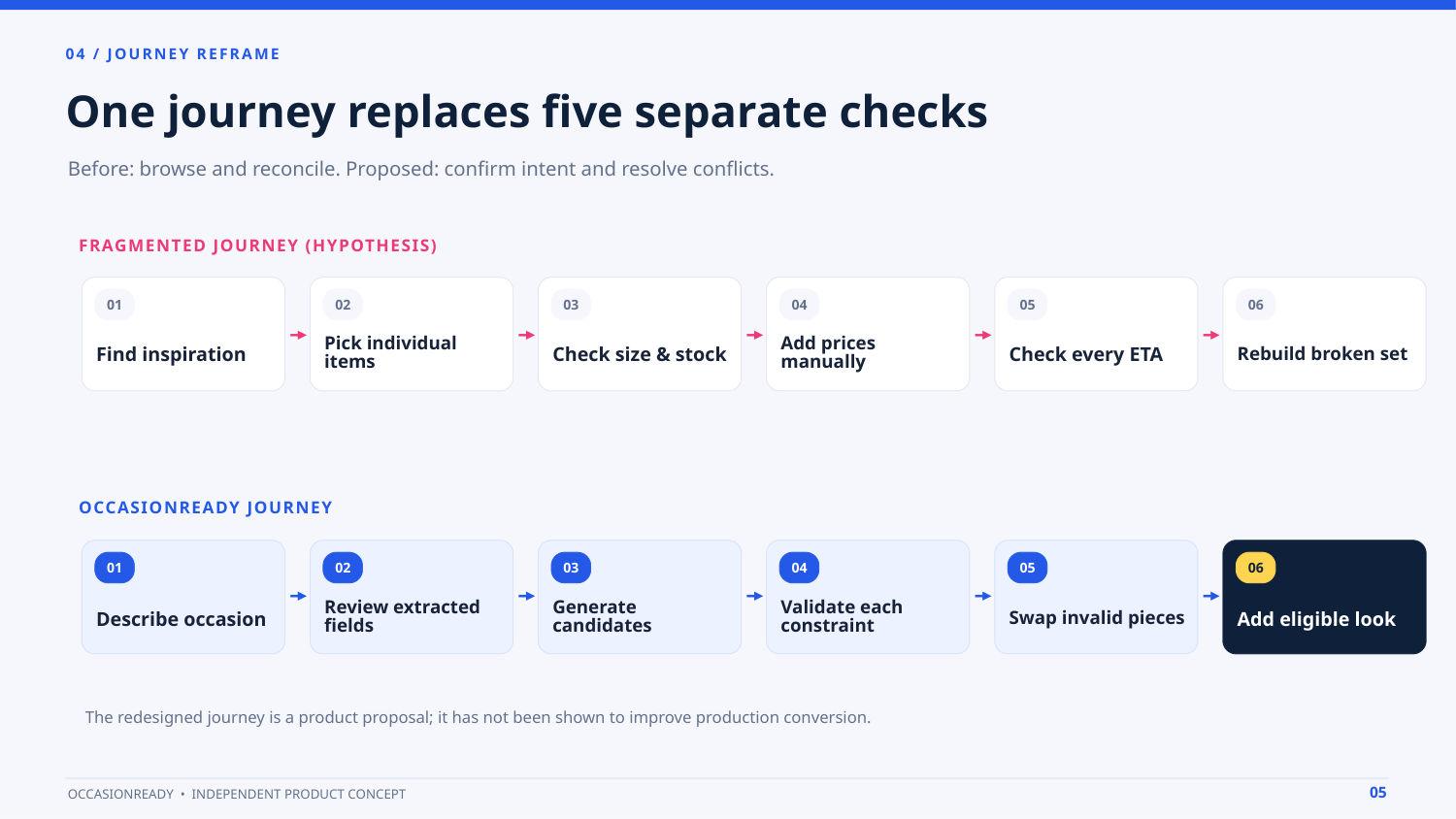
One journey replaces five separate checks
ProposalFragmented today (hypothesis): find inspiration, pick items, check size and stock, add prices by hand, check every delivery date, rebuild the broken set.
Proposed: describe the occasion, review extracted fields, generate candidates, validate each constraint, swap invalid pieces, add the eligible look.
Why a planner, not another chatbot
ProposalChoose the smallest intervention that addresses the defining purchase barrier.
Selection logic: expected impact on feasibility × implementability on a demo catalog × clarity of customer feedback.
Option 1· Rejected
Smart search and filters. Lower disruption, but shoppers still assemble and cross-check whole baskets. Doesn't enforce bundle feasibility.
Option 2· Rejected
Generative stylist only. High inspiration value, but can return appealing, unshoppable looks.
Option 3· Selected for MVP
Constraint-aware complete-look planner. Turns intent into an eligible, editable bundle with visible checks.
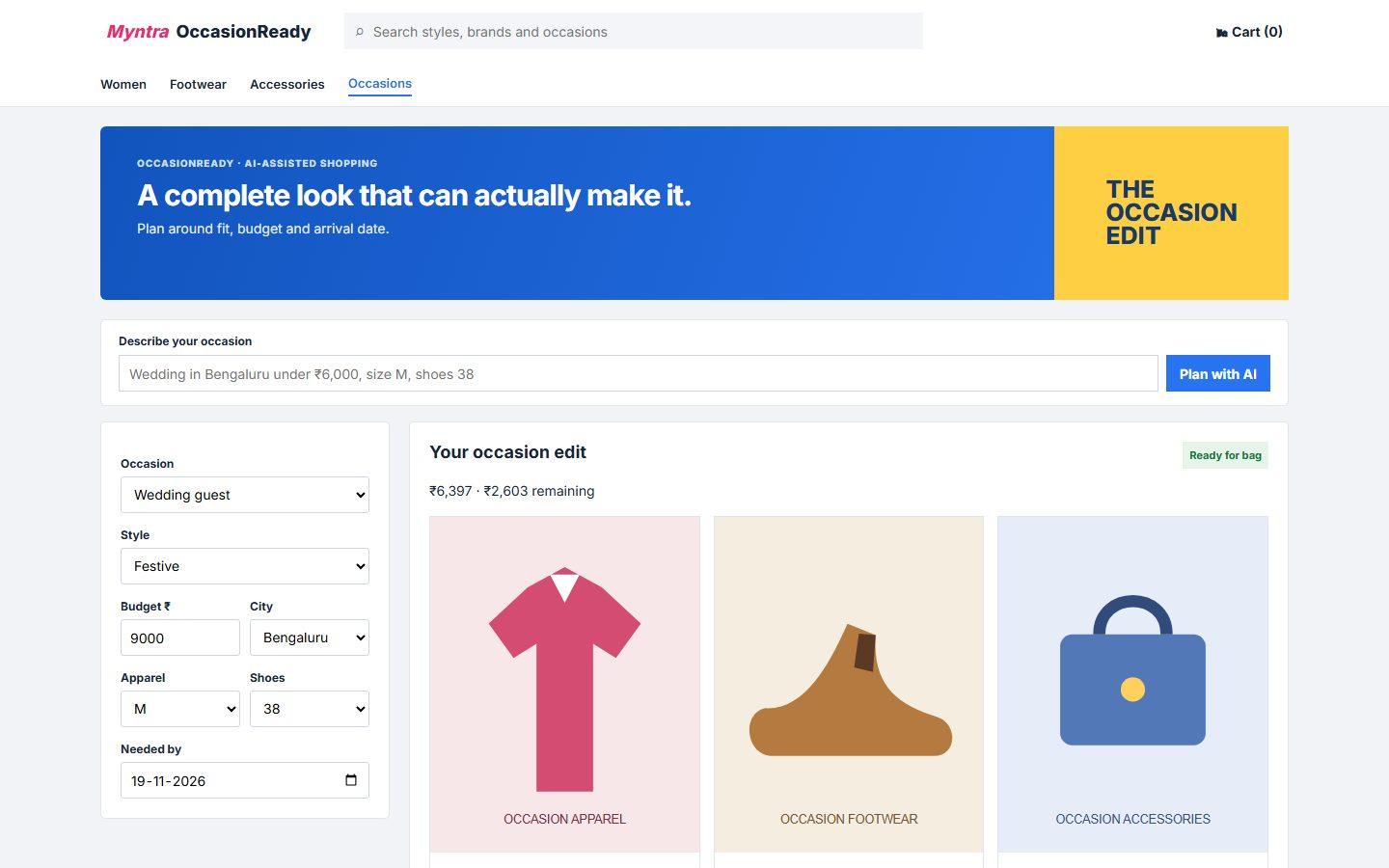
The MVP: an itemised, editable bundle
BuiltThe visible outcome is a bundle the shopper can inspect and change, not a list of suggestions.
- Capture intent: occasion, style, city, sizes, total budget and date.
- Explain validity: item price, delivery date and eligibility state stay visible.
- Keep user control: change one piece or return to the planner.
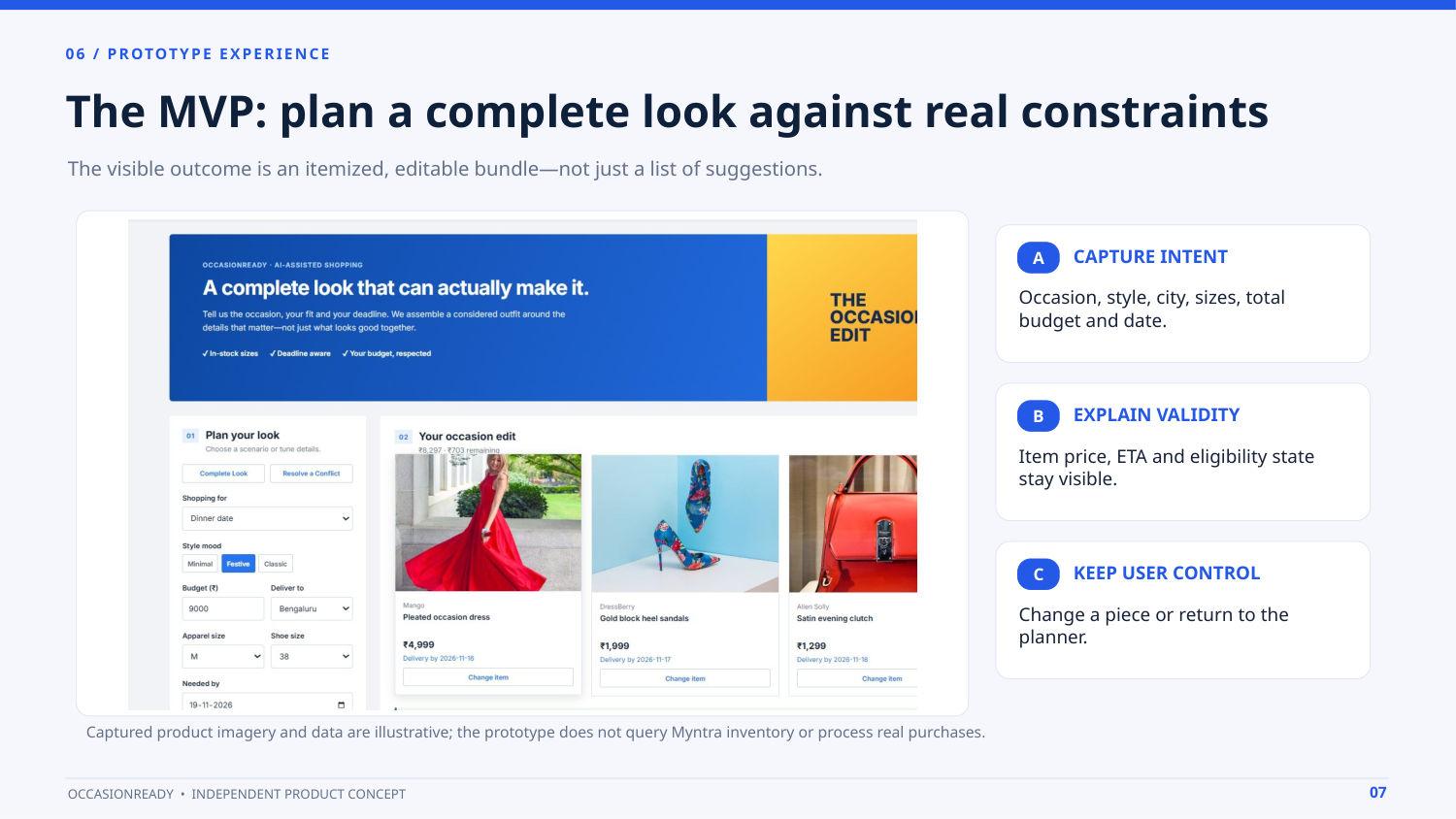
Boundary. The prototype does not query Myntra inventory or process real purchases.
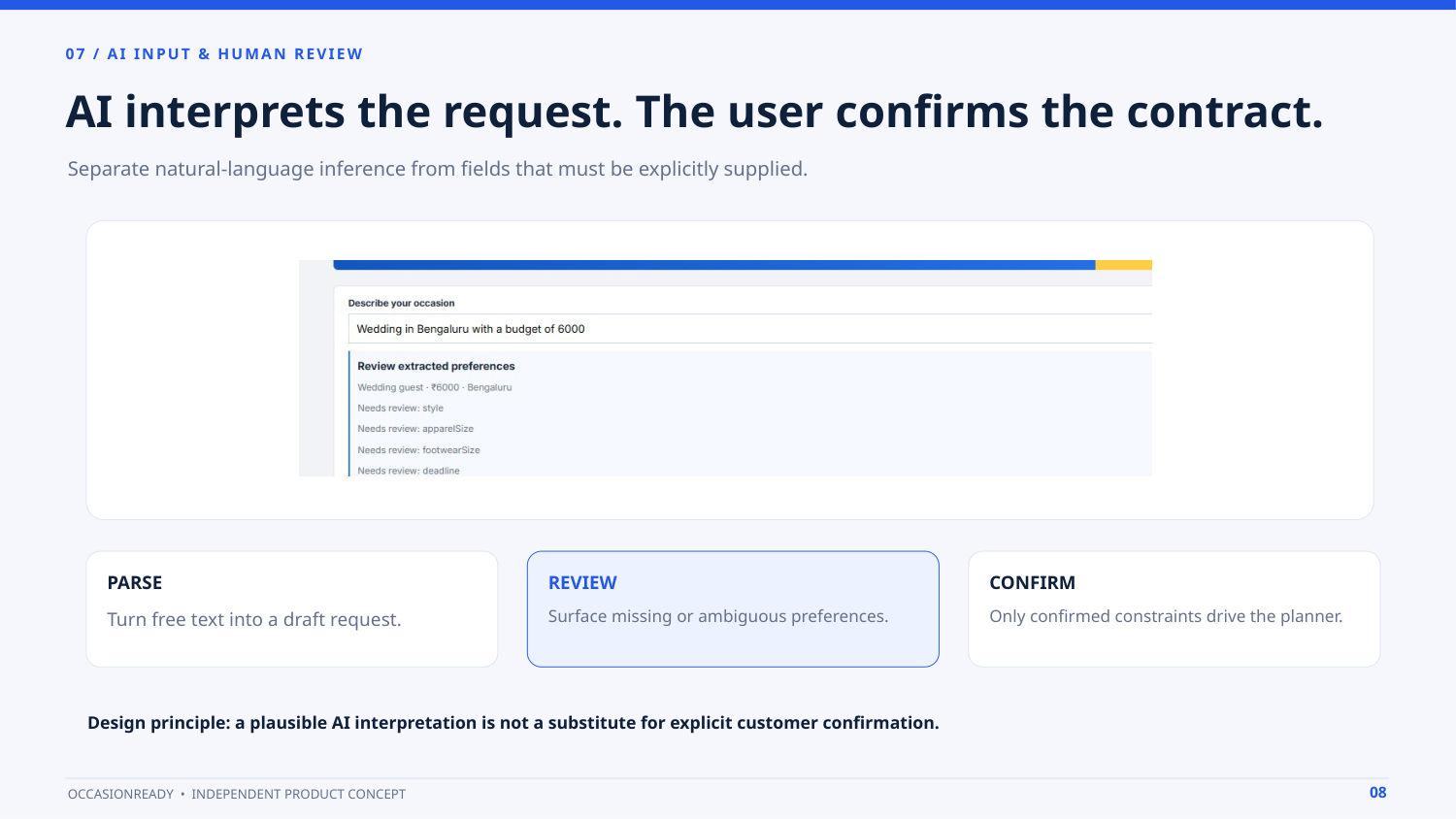
AI interprets the request. The shopper confirms the contract.
BuiltFree text becomes a draft request. Missing or ambiguous preferences are surfaced for review. Only confirmed constraints drive the planner.
Design principle: a plausible AI interpretation is not a substitute for explicit customer confirmation.
Deterministic rules at the purchase boundary
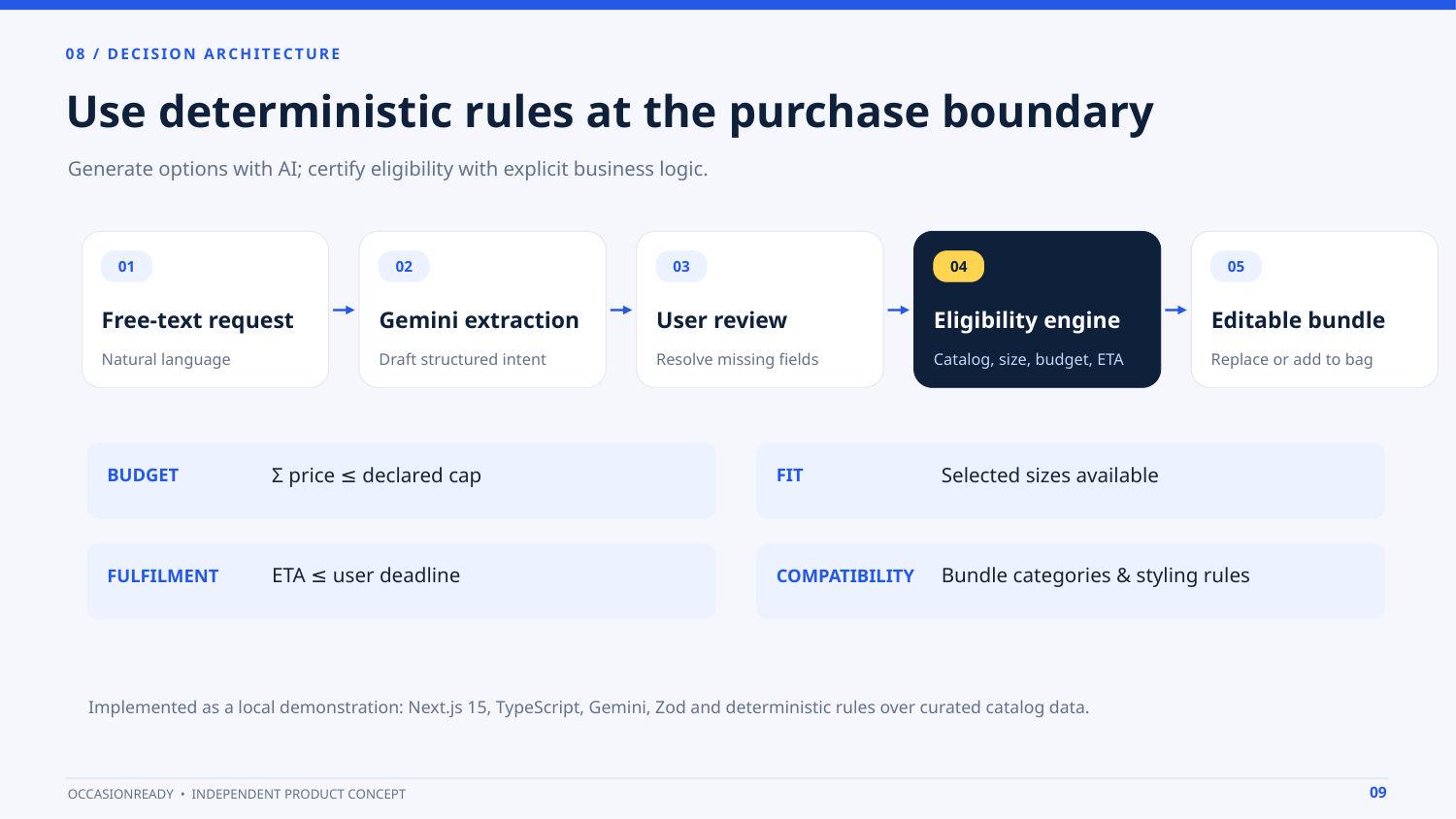
BuiltGenerate options with AI; certify eligibility with explicit business logic.
Implemented as a local demonstration in Next.js 15 and TypeScript, using Gemini for extraction, Zod for validation and rules over curated catalog data.
- Budget: total price within the declared cap.
- Fit: selected sizes are available.
- Fulfilment: delivery date on or before the shopper's deadline.
- Compatibility: bundle categories and styling rules.
A useful failure beats a confident, invalid answer
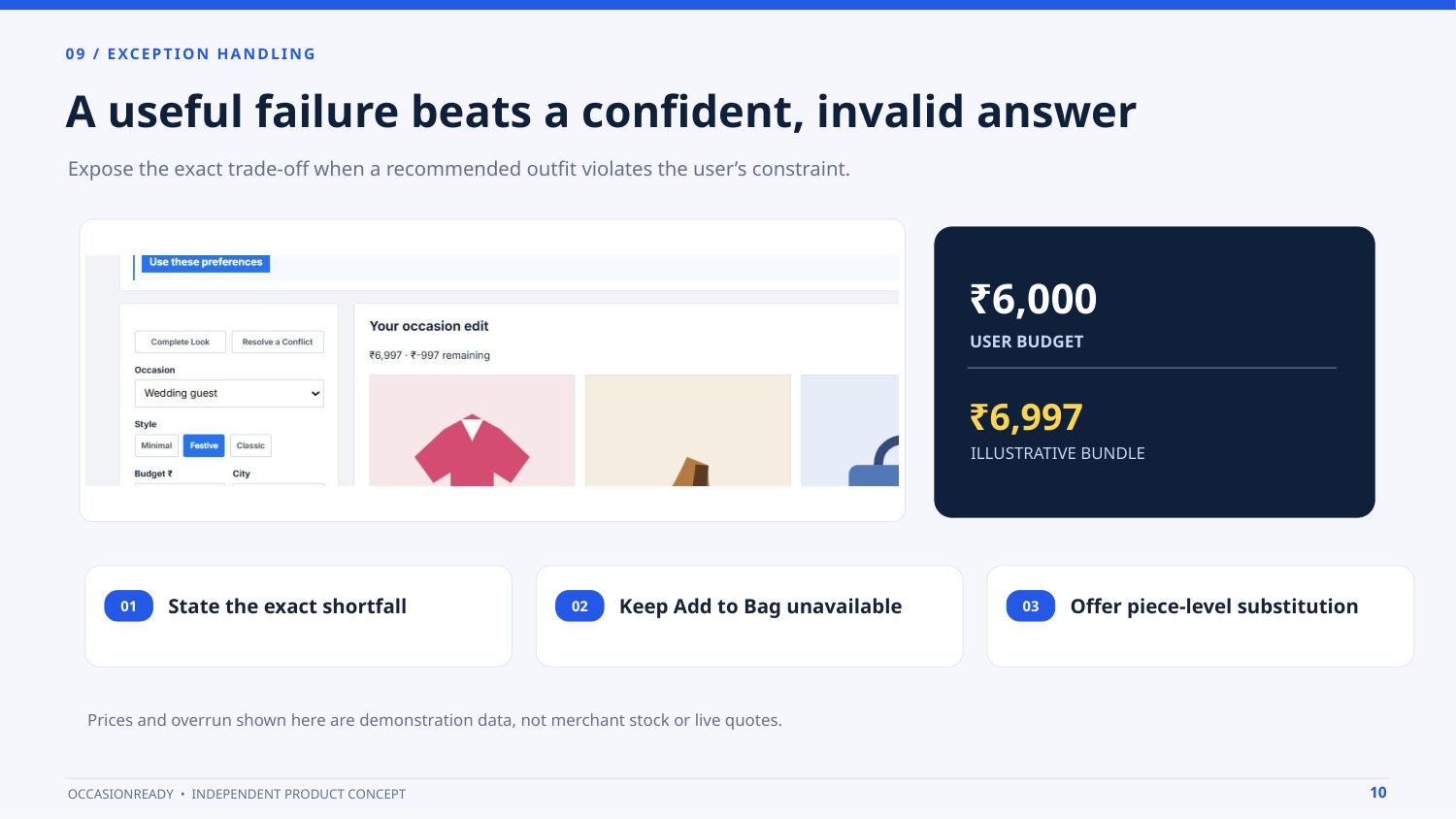
BuiltWhen a recommended outfit breaks the budget, the product states the exact shortfall, keeps Add to Bag unavailable and offers piece-level substitution.
In the deck's example, a ₹6,997 bundle against a ₹6,000 budget is shown as demonstration data.
Measure successful decisions, not prompt count
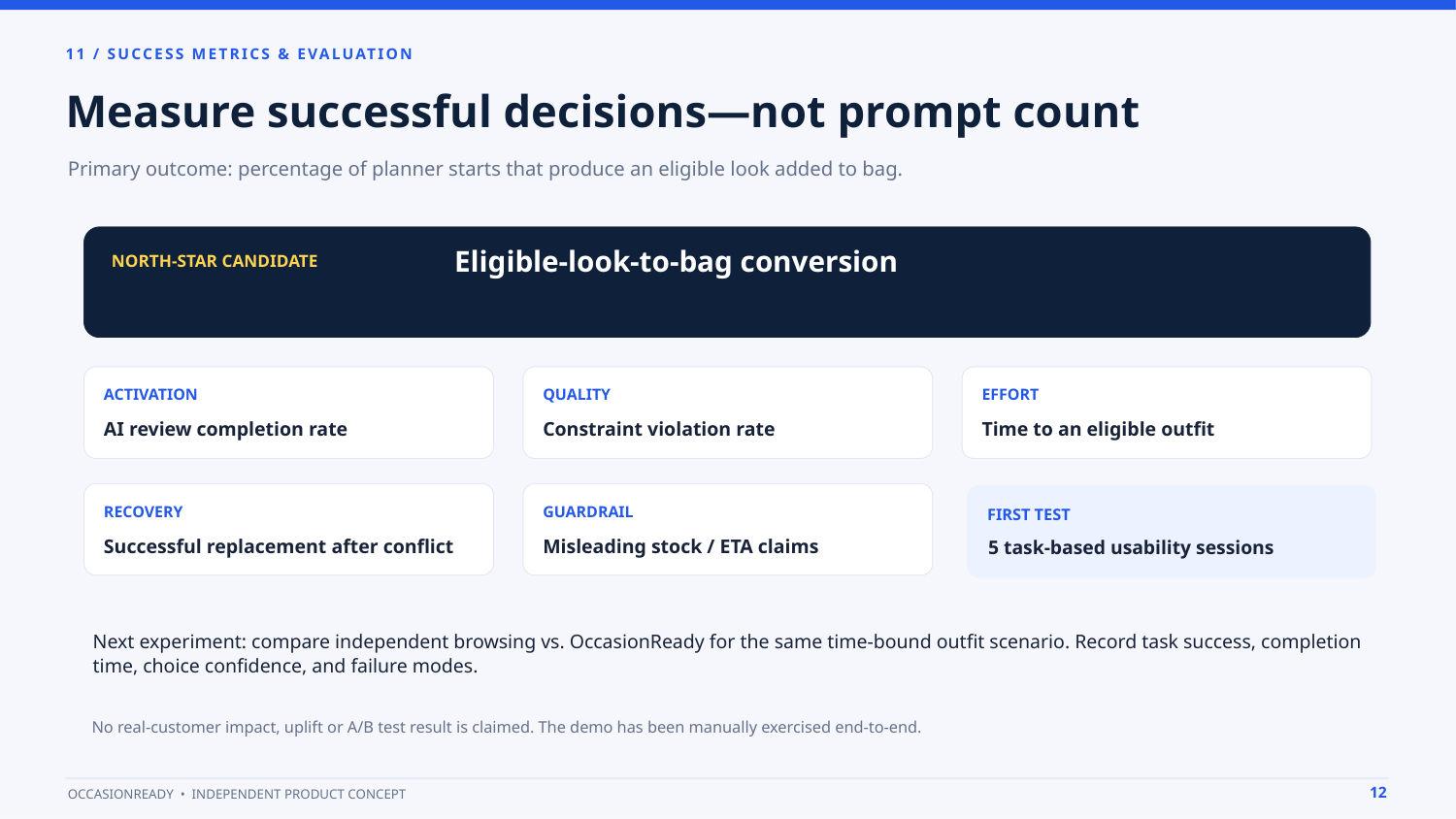
TargetPrimary outcome: the share of planner starts that produce an eligible look added to the bag.
First test: five task-based usability sessions, then a comparison of independent browsing against OccasionReady for the same time-bound outfit task, recording task success, completion time, choice confidence and failure modes.
- North-star candidate: eligible-look-to-bag conversion.
- Activation: AI review completion rate.
- Quality: constraint violation rate.
- Effort: time to an eligible outfit.
- Recovery: successful replacement after a conflict.
- Guardrail: misleading stock or delivery claims.
Boundary. No real-customer impact, uplift or A/B result is claimed. The demo has been manually exercised end to end.
Limits and next bets
“Ready for bag” means ready under the illustrative catalog rules, not a live fulfilment guarantee.
Production readiness needs live catalog and stock data, delivery-time accuracy, instrumentation and a real user study.
Sources
- Microsoft / Myntra, AI First Movers (Dec 2023): cited in the project deck
- Business Standard, Myntra AI coverage (Jul 2026): cited in the project deck