Networking workflows · AI product experience · Product teardown
Nexora
From contacts to useful follow-through: a product teardown, current-workflow analysis and evidence-aware UX redesign for an AI-assisted professional networking workspace.
- Status
- Deployed application · teardown and redesign
- My role
- Built the application; wrote the product teardown, UX critique and proposed workflow.
Teardown of Nexora, a full-stack application I built. The redesign is a concept.
- Open teardown PDF (opens in a new tab)
- Open application (opens in a new tab)Opens a sign-in screen; an account is required.
- View repository (opens in a new tab)
In two minutes
- Problem: contact storage isn't relationship momentum. Value comes from closing the loop between context and action.
- Finding: relationships, preparation, recommendations and follow-ups live in different modules, so a feature-rich CRM can lose the user. These are hypotheses to test.
- Proposal: one relationship workspace where each AI suggestion exposes source context, confidence limits and an editable action.
- Unproven: no user study, retention or engagement result. The redesigned screen is a concept wireframe.
Built
- Contacts, events and interaction history
- Conversation preparation with fact-checking
- Recommendations and relationship insights
- Follow-up lifecycle and feedback
- A deployed frontend (sign-in required)
Proposed
- Unified relationship workspace
- Explainable next action
- Evidence-quality labels and user editing
- Outcome feedback loop (completed, dismissed, stale)
Not claimed
- User-study results, retention or engagement gains
- Customer adoption or product-market fit
- That the redesigned screen exists: it is a concept wireframe
Contact storage is not relationship momentum
BuiltNexora combines contact management, event preparation, recommendations, follow-ups and feedback in one application.
Record
Contacts, interactions, events, notes, profiles and follow-ups.
Prepare
Conversation starters, fact checking, history and quality guards, with optional public context.
Act and learn
Recommended actions, action lifecycle, follow-up conversion, feedback and analytics.
The job happens before and after a conversation
HypothesisIllustrative user: an early-career professional who meets people at events but struggles to keep context and follow through consistently.
Job to be done: help me remember the relationship, prepare credibly and follow up while the conversation still matters.
Boundary. The persona is a design hypothesis based on feature scope, not a researched or interviewed segment.
What the product does today
BuiltFour modules, plus personalisation, user-scoped history, admin-only diagnostics and fallback behaviour.
- Relationships: contacts, events and interactions.
- Prep: generate conversation starters and fact-check them.
- Intelligence: suggestions and graph insights.
- Follow-through: action lifecycle and follow-ups.
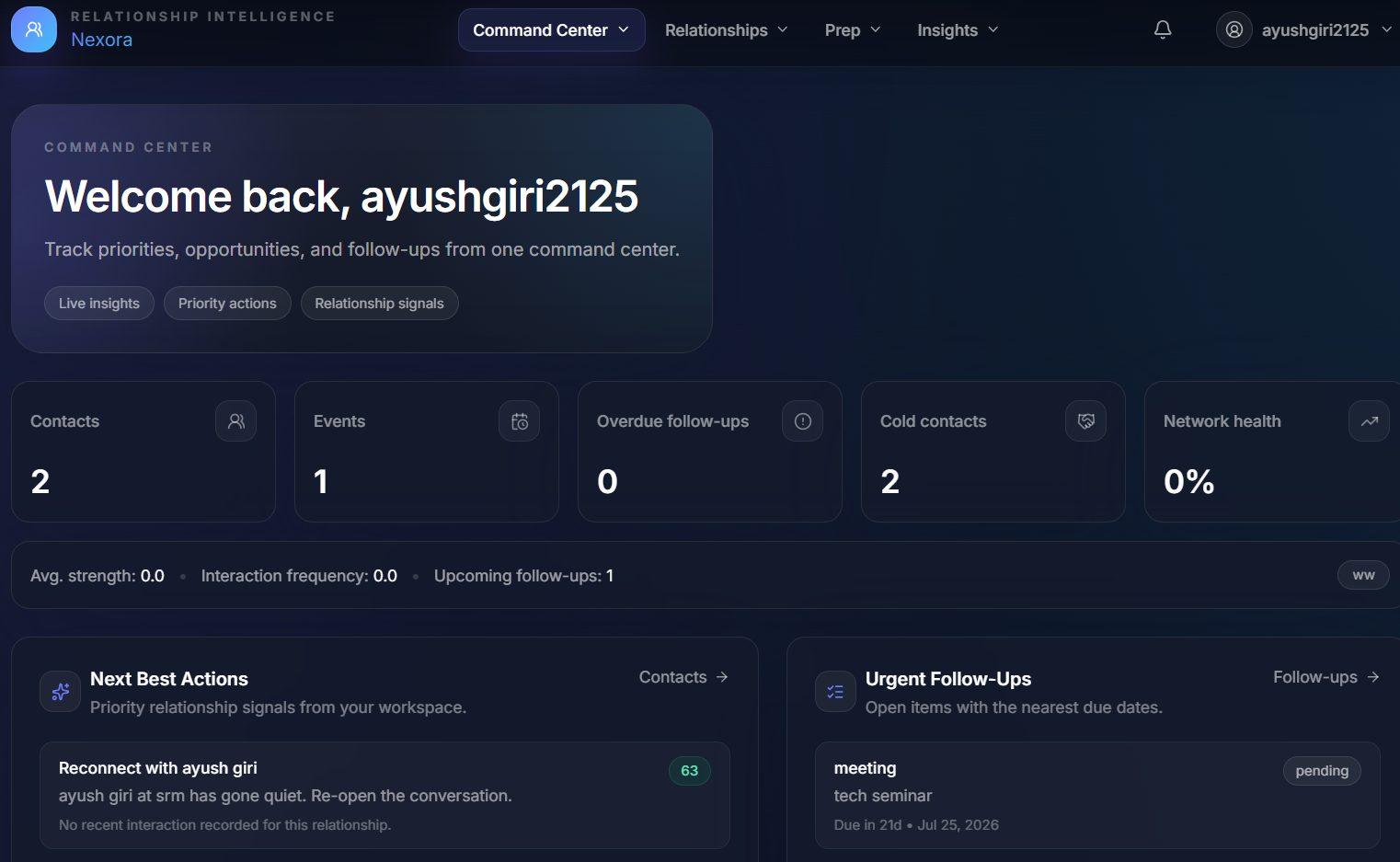
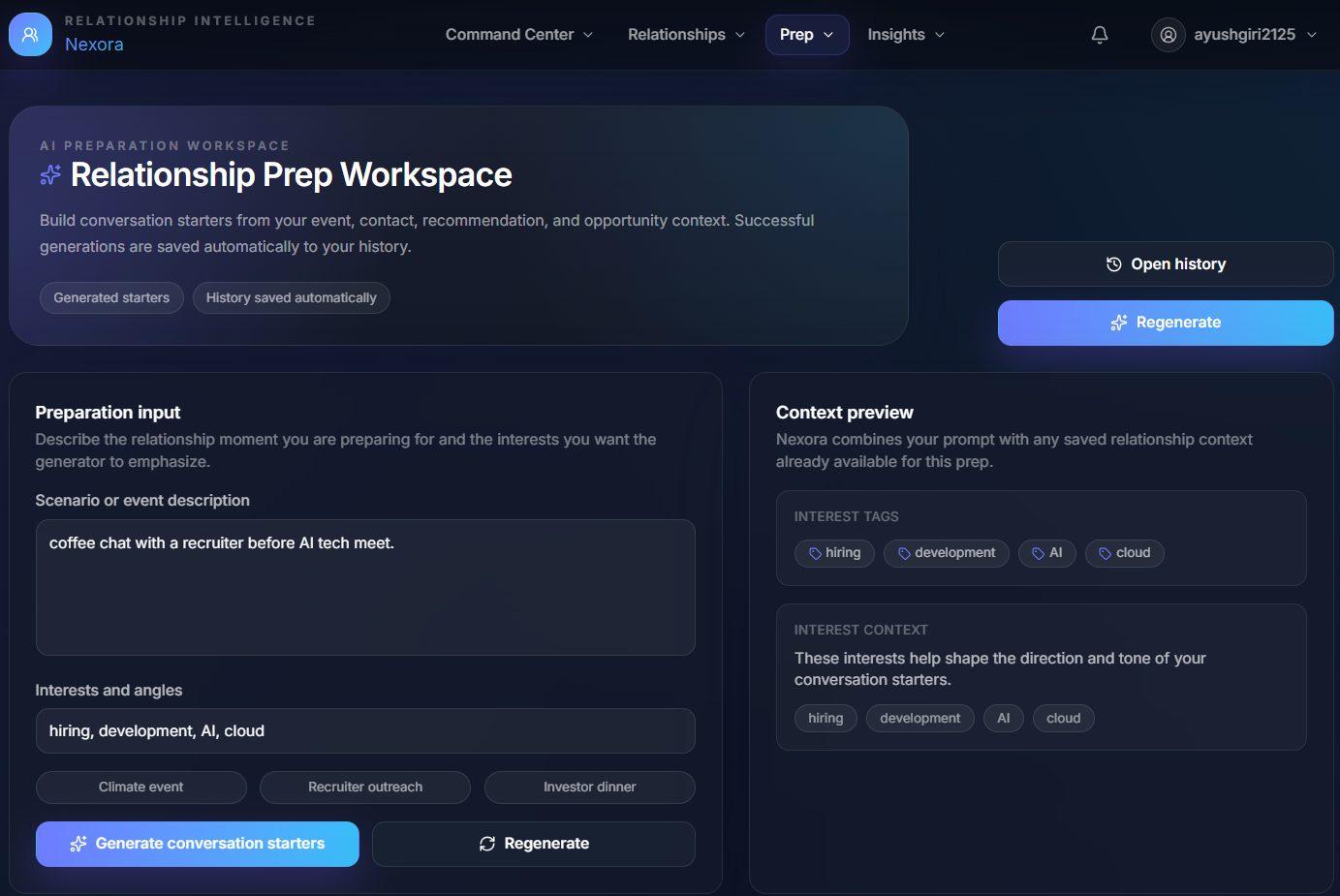
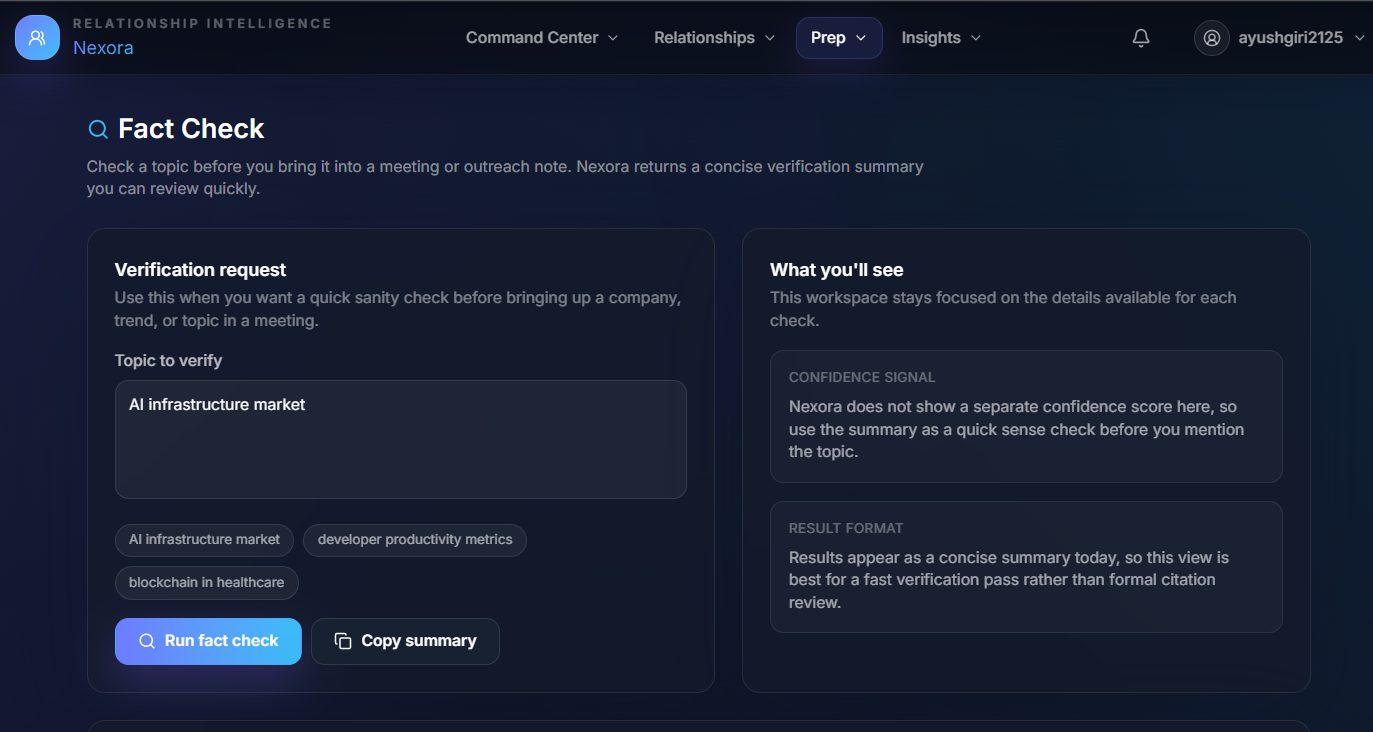
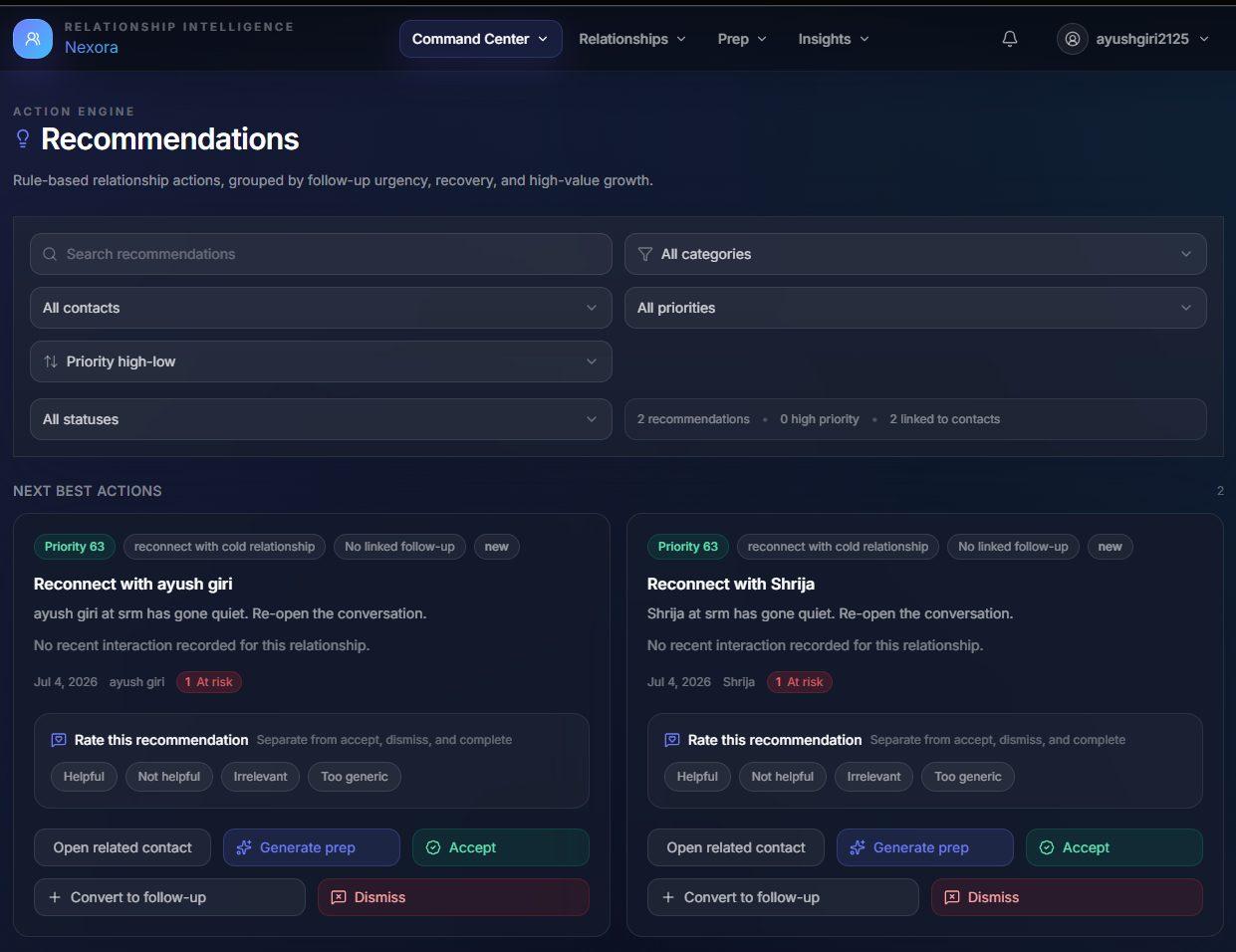
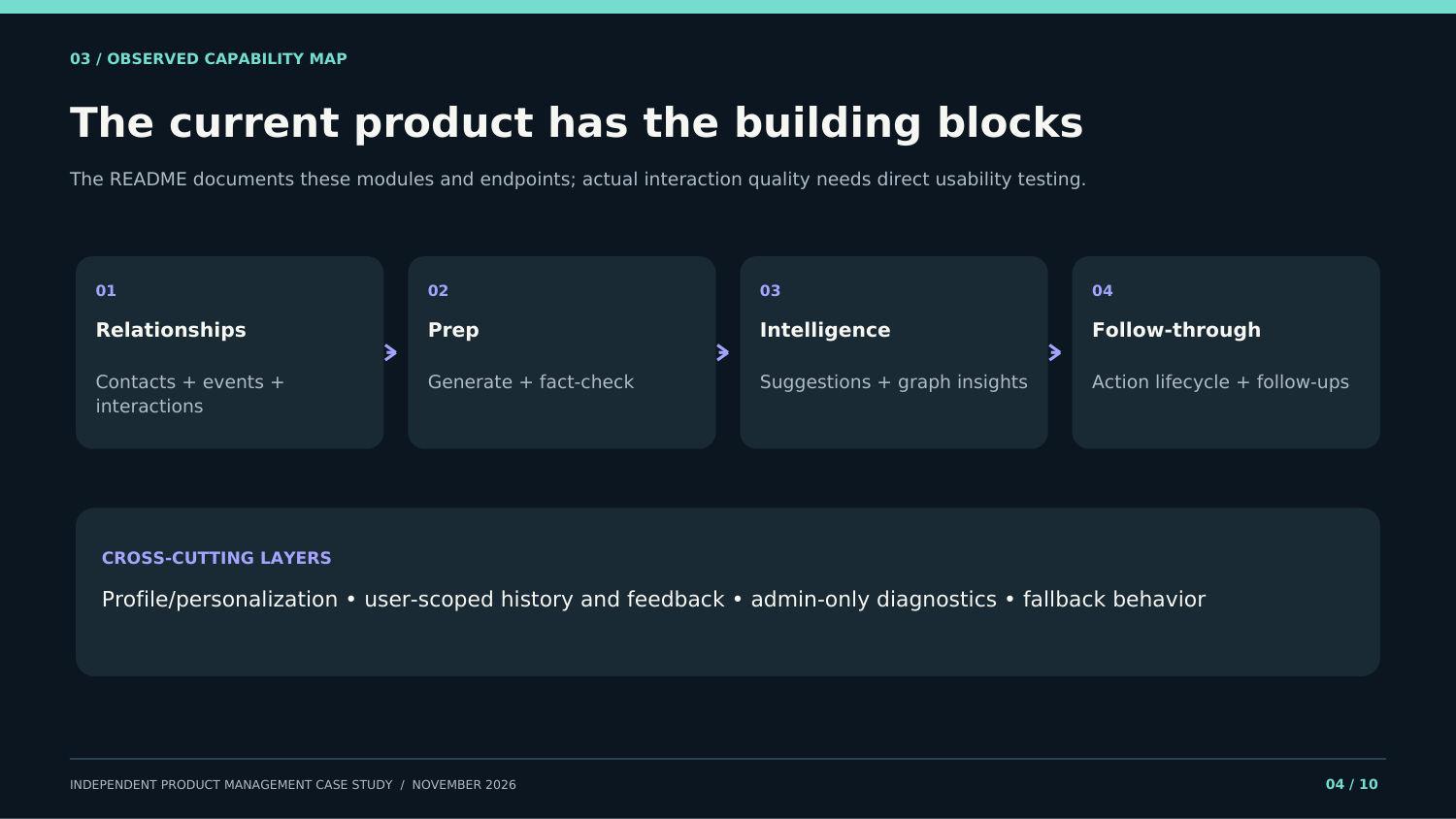
Boundary. The README documents these modules. Actual interaction quality needs direct usability testing.
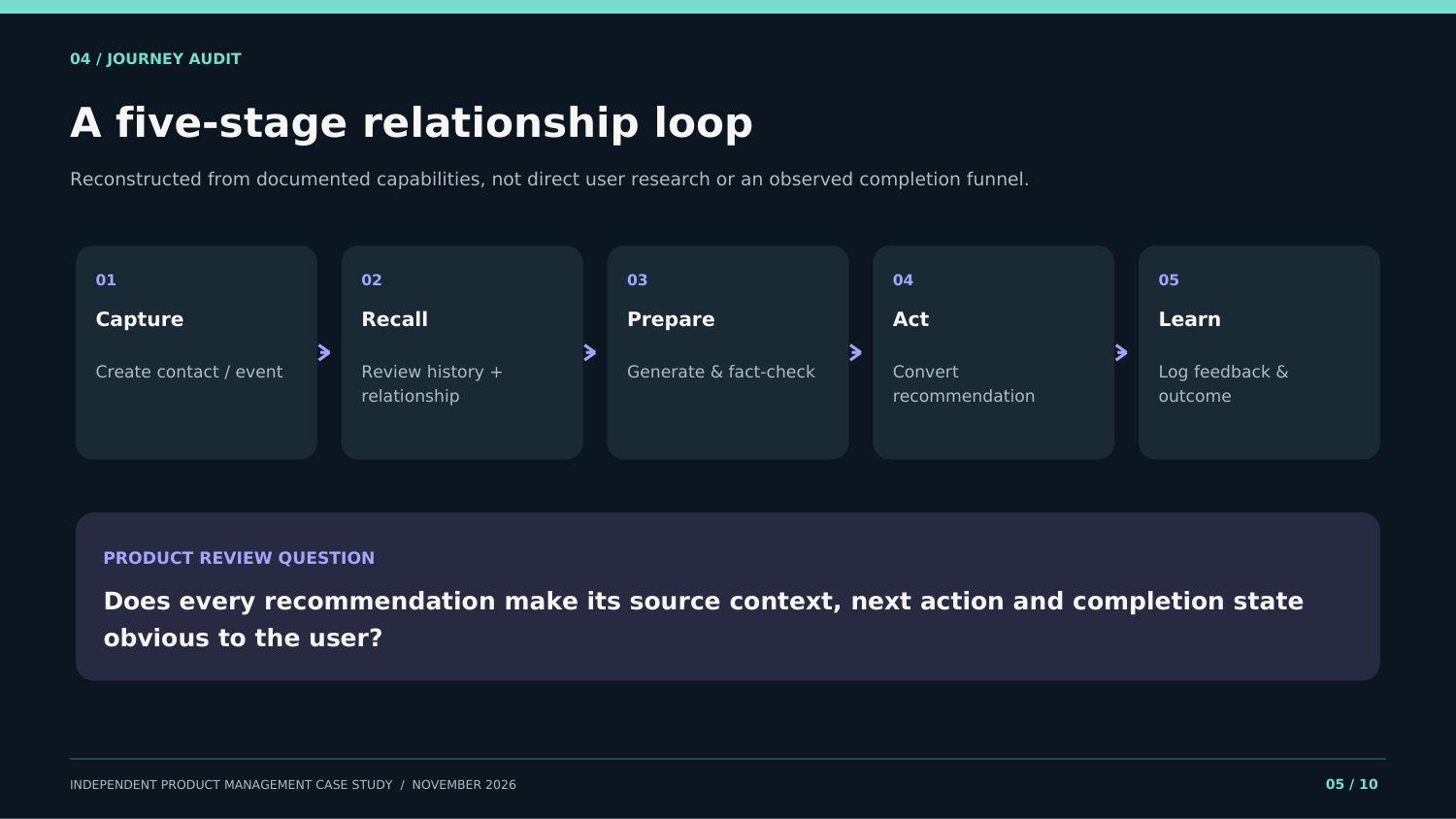
A five-stage relationship loop
HypothesisCapture a contact or event, recall history, prepare and fact-check, act by converting a recommendation, then learn by logging feedback and outcome.
Review question: does every recommendation make its source context, next action and completion state obvious?
Where a feature-rich CRM may lose the user
HypothesisContext fragmentation
Relationships, prep, recommendations and follow-ups span modules, so cross-navigation may add effort.
AI credibility
Generated starters need traceable context, clear fallback states and user editability.
Action ambiguity
A recommendation needs an owner, a priority, a rationale and an explicit lifecycle outcome.
Boundary. These are hypotheses requiring walkthroughs and user tests, not proven Nexora defects or observed churn.
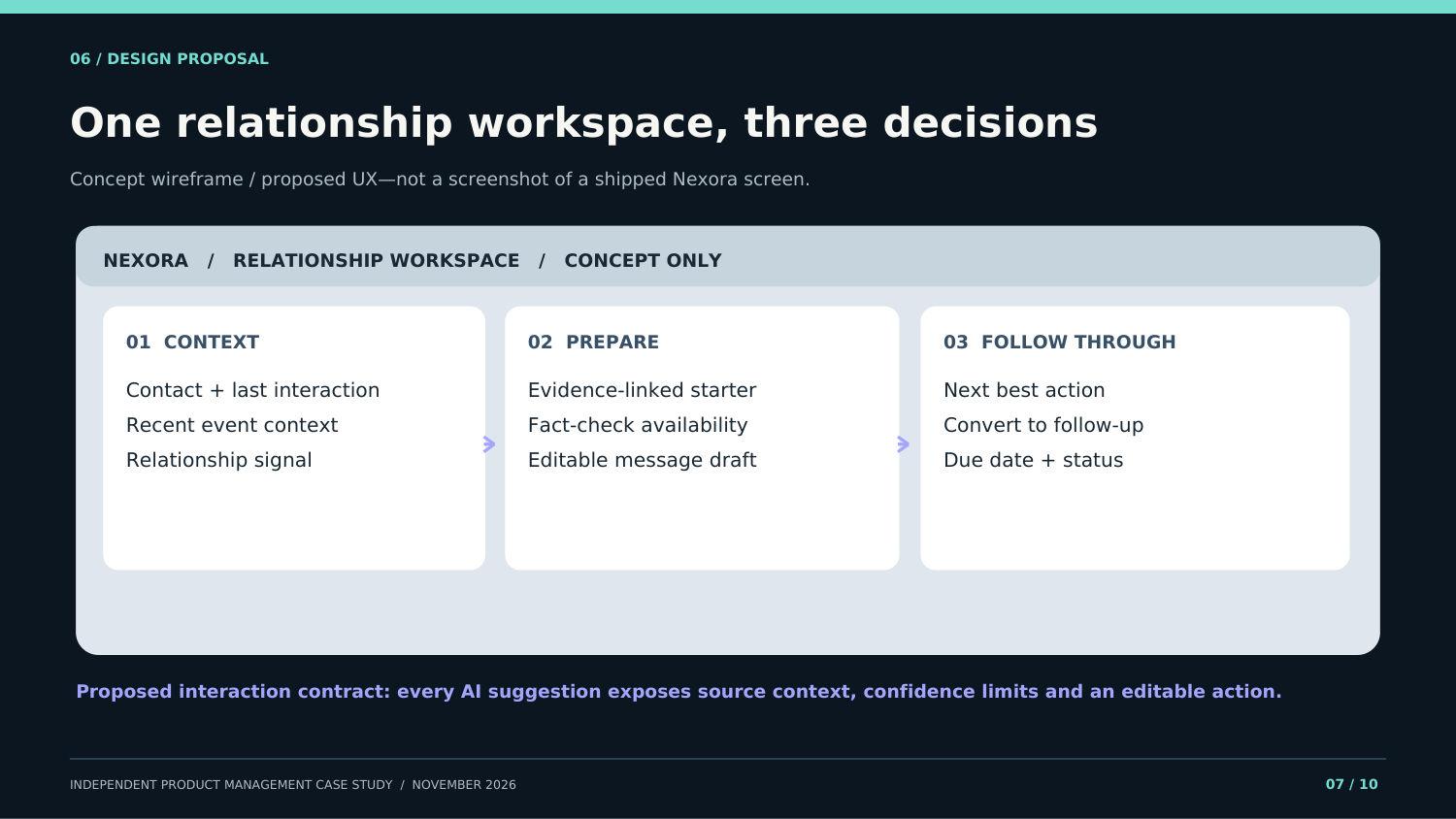
One relationship workspace, three decisions
ProposalContext shows the contact, last interaction, recent event and a relationship signal. Prepare shows an evidence-linked starter, fact-check availability and an editable draft. Follow through shows the next best action, converts it to a follow-up and sets a due date and status.
Proposed interaction contract: every AI suggestion exposes source context, confidence limits and an editable action.
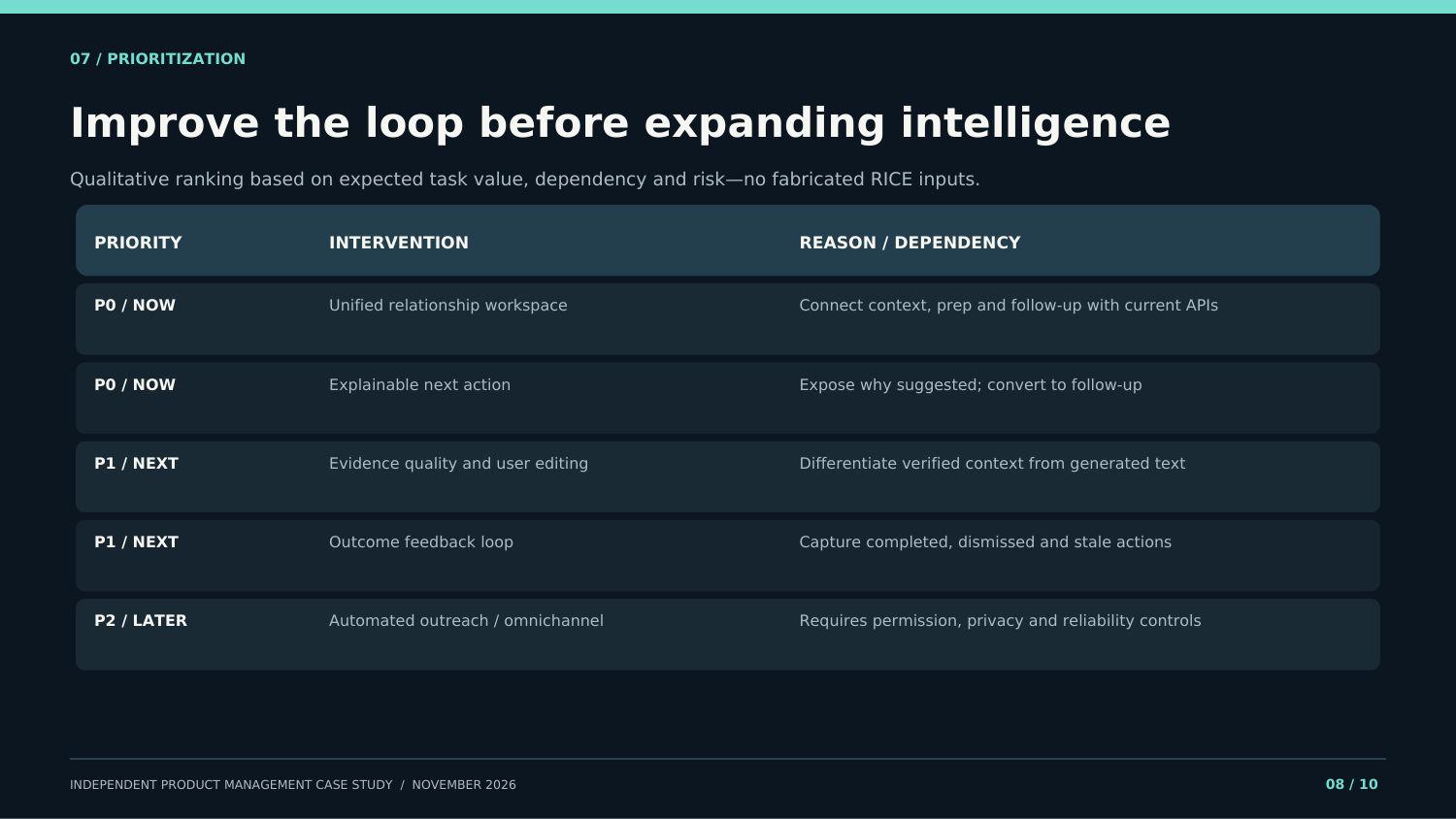
Improve the loop before expanding intelligence
ProposalQualitative ranking by expected task value, dependency and risk. No invented RICE inputs.
P0 · Now
Unified relationship workspace: connect context, prep and follow-up using current APIs.
P0 · Now
Explainable next action: show why it was suggested and convert it to a follow-up.
P1 · Next
Evidence quality and user editing: distinguish verified context from generated text.
P1 · Next
Outcome feedback loop: capture completed, dismissed and stale actions.
P2 · Later
Automated outreach and omnichannel: needs permission, privacy and reliability controls first.
Test whether users finish relationship tasks
Target- Primary: share of prep sessions that end in a deliberate, saved next action.
- Efficiency: time from opening a relationship to scheduling a follow-up.
- Quality: user rating of suggestion relevance and context accuracy.
- Experiment: a moderated comparison of the existing multi-module task against the proposed unified flow, observing navigation, edits, confidence and next-action completion.
- Guardrails: incorrect facts, misleading AI certainty, excessive alerts, privacy exposure and failed follow-up writes.
Boundary. Proposed evaluation only. No user-study results, retention gains or engagement uplift are claimed.
The system and its limits
Built with a React/Vite frontend and a FastAPI backend over relational data, with authentication, recommendations, relationship scores, graph insights, prep and fact-check, and optional public-context lookup with guarded fallbacks.
A feature-rich public portfolio project is not evidence of customer adoption or product-market fit. Retention and task success are unmeasured, and AI and context quality still need hands-on verification.