Market analysis · Product strategy · Scientific-evidence assessment
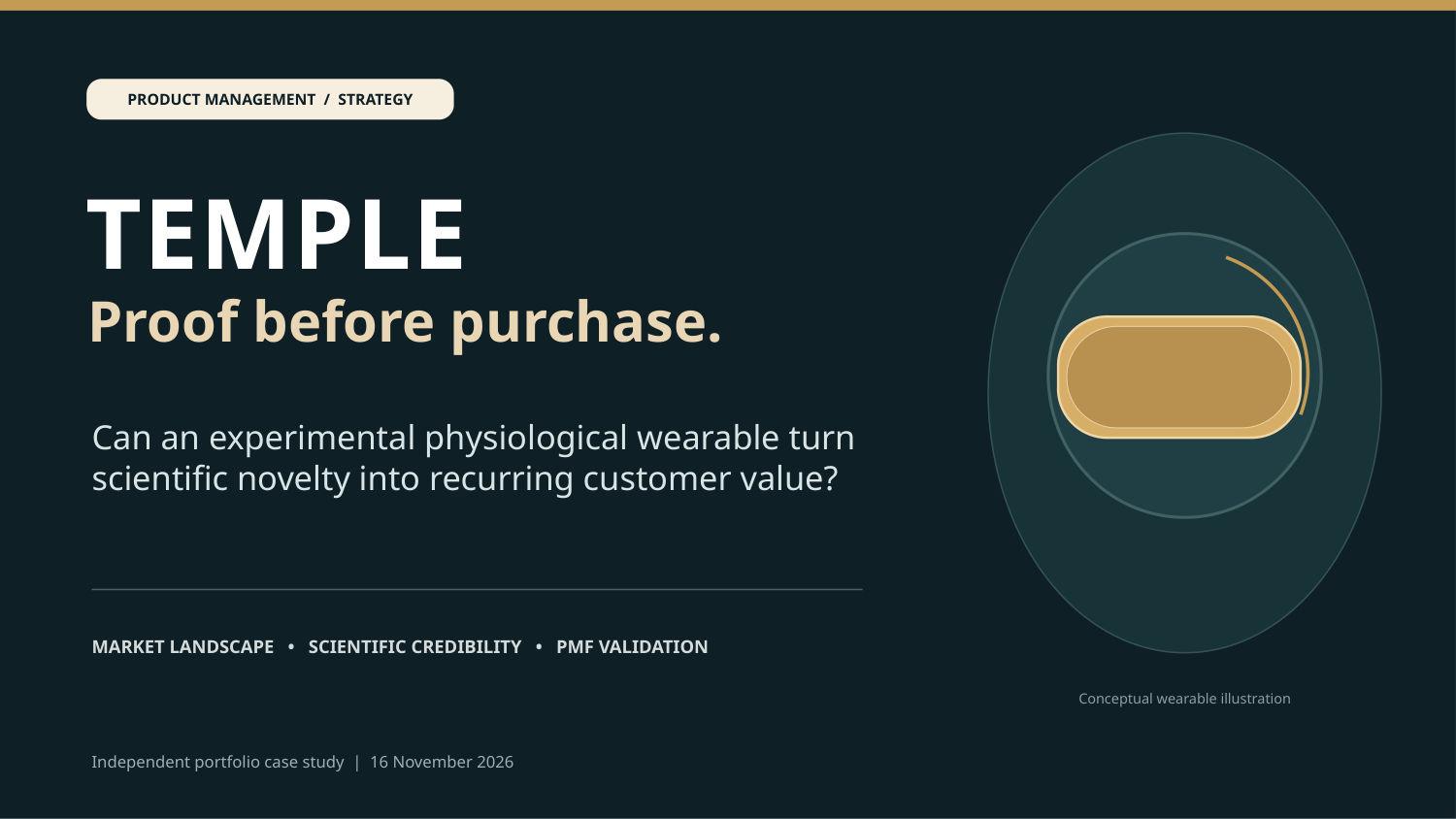
Temple — Proof Before Purchase
A strategy teardown of a premium experimental wearable: competitive landscape, scientific credibility, segments, purchase barriers and a staged validation plan.
- Status
- Independent strategy teardown · no product built
- My role
- Competitive analysis, evidence assessment, segmentation and validation design.
Independent portfolio case study, 16 November 2026. Based on public sources; no Temple company data.
In two minutes
- Question: can sensor novelty become a reason to keep wearing and paying for a ₹85,000 device?
- Insight: signal observed, measurement relevance, clinical validity and an actionable outcome are four separate claims.
- Recommendation: build purchase confidence first with a “Proof-to-Purchase” evidence experience, then validate with expert early adopters.
- Unproven: segments, priorities and metrics are my hypotheses. No buyer interviews were conducted.
Built
- Competitive comparison, evidence-quality framework, segmentation and prioritisation (the strategy document)
Proposed
- Proof-to-Purchase evidence journey
- Three-stage validation programme: interviews, content experiment, longitudinal use study
Not claimed
- Primary buyer interviews
- Any Temple company data or affiliation
- Validation of BrainFlow or Entropy claims, or of any health benefit
A premium wearable built around unfamiliar signals
ResearchTemple promises a new lens on physiology. Its commercial value is still to be established.
- ₹85,000
- India launch price
- 1 Nov 2026
- Pre-orders opened
- ~3 months
- Reported delivery wait
From NDTV Profit (1 Nov 2026), Temple's website and Reuters (11 Nov 2026), as cited in the document.
- BrainFlow: a proprietary optical index that Temple describes as intended to track brain-related circulation changes. Interpretation and clinical relevance remain contested.
- Entropy: a proprietary index of metabolic and sympathetic demand, with a proposed link to recovery and performance.
- Positioning: a wellness device, not a clinically established diagnostic instrument.
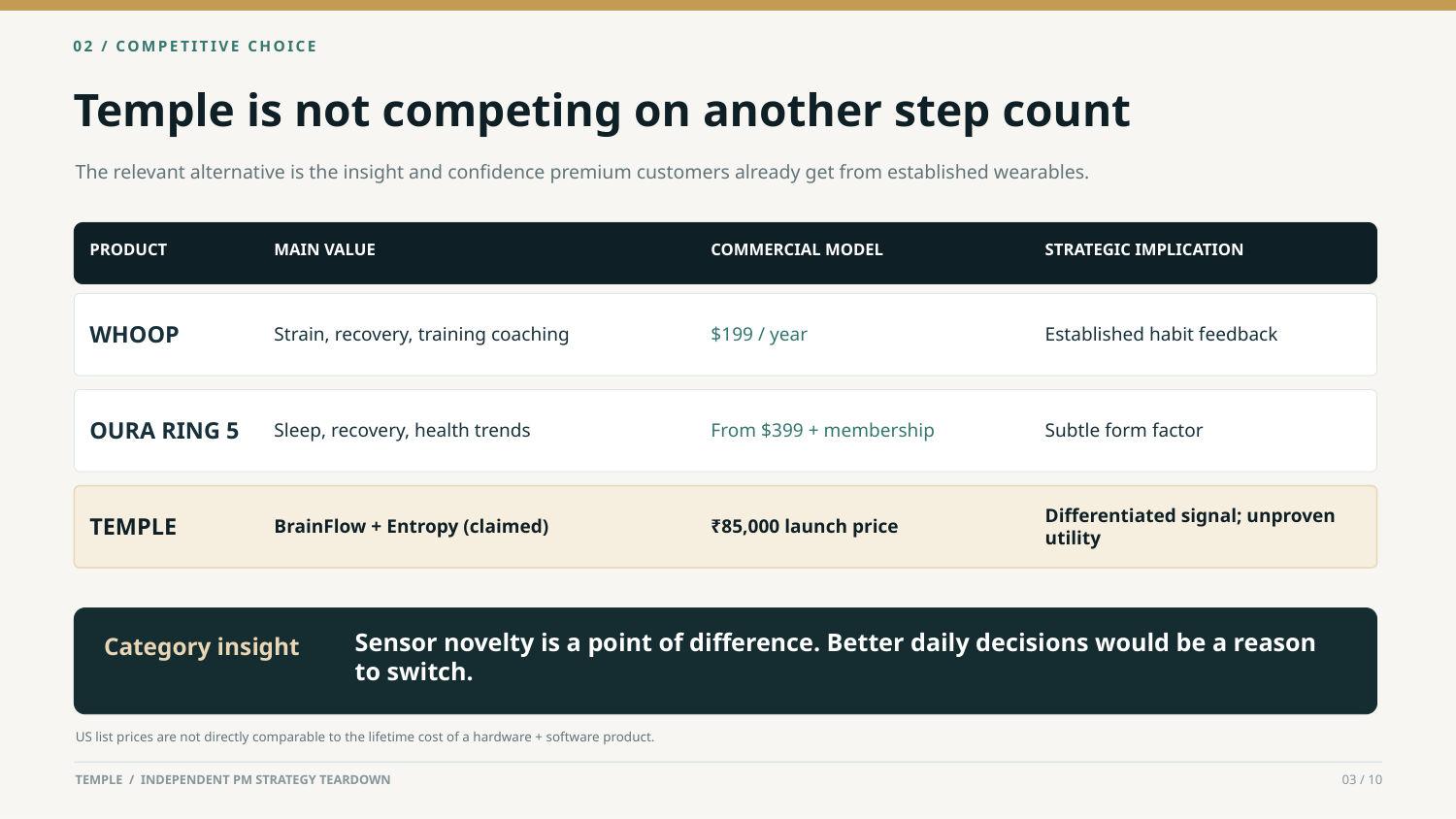
Not competing on another step count
ResearchThe real alternative is the insight and confidence premium customers already get from established wearables.
Category insight: sensor novelty is a point of difference. Better daily decisions would be the reason to switch.
WHOOP
Strain, recovery and training coaching. $199 per year. Established habit feedback.
Oura Ring 5
Sleep, recovery and health trends. From $399 plus membership. Subtle form factor.
Temple
BrainFlow and Entropy (claimed). ₹85,000 launch price. A differentiated signal with unproven utility.
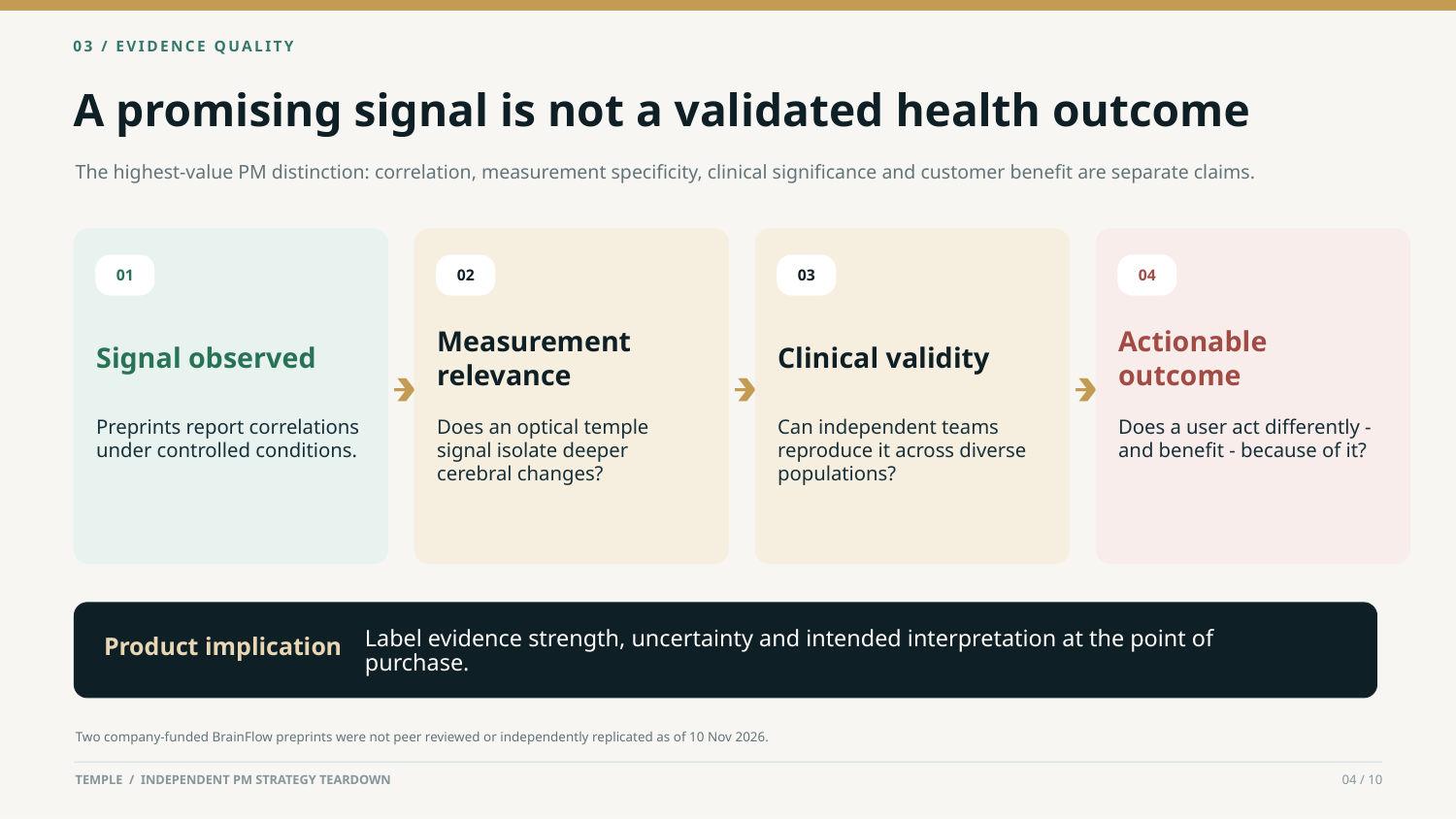
A promising signal is not a validated health outcome
ResearchThe most useful PM distinction: correlation, measurement specificity, clinical significance and customer benefit are separate claims.
Product implication: label evidence strength, uncertainty and intended interpretation at the point of purchase.
- Signal observed: preprints report correlations under controlled conditions.
- Measurement relevance: does an optical temple signal isolate deeper cerebral changes?
- Clinical validity: can independent teams reproduce it across diverse populations?
- Actionable outcome: does a user act differently, and benefit, because of it?
Boundary. This page makes no claim that Temple's measurements are valid or invalid. It describes what the cited sources support.
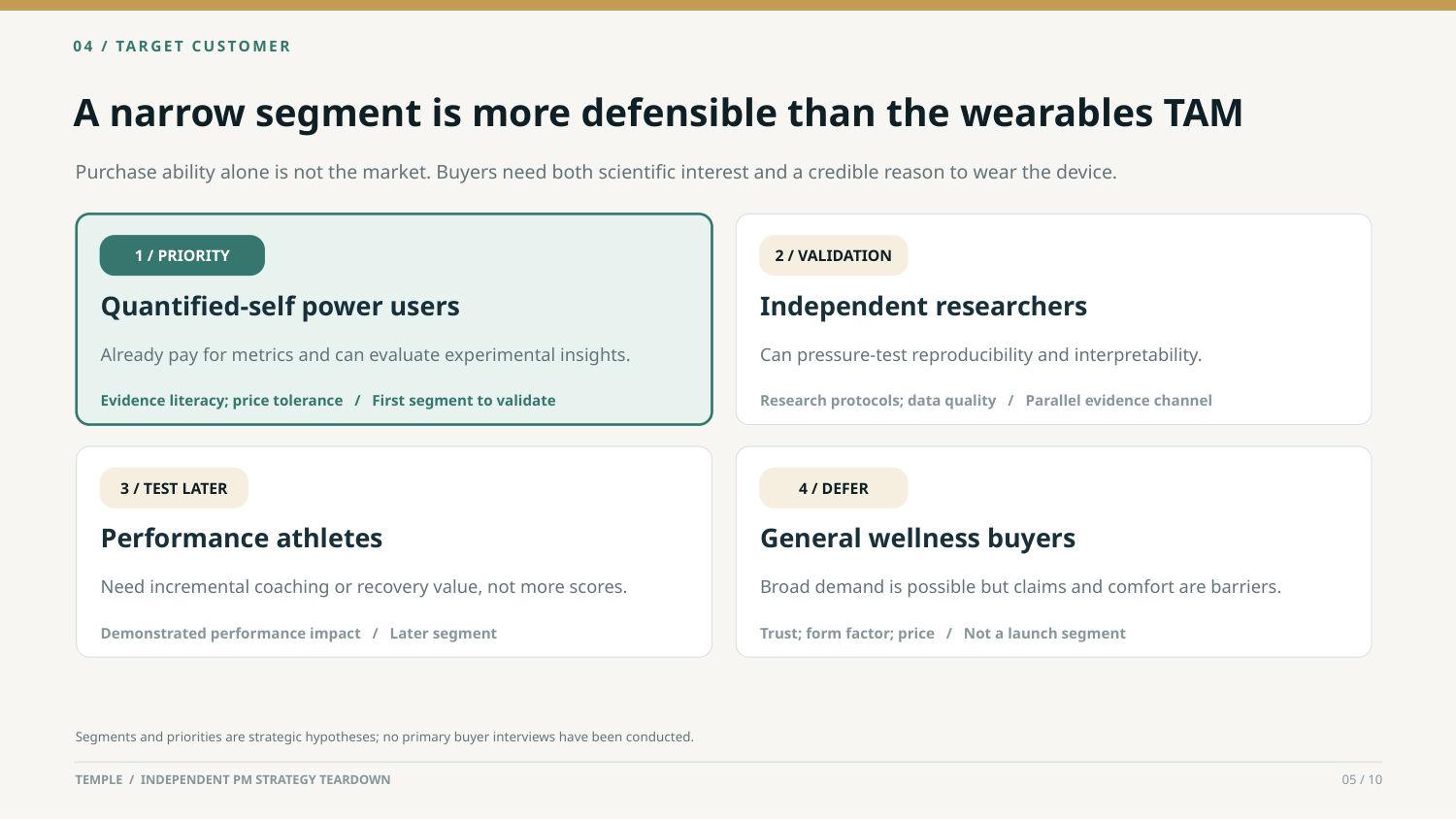
A narrow segment is more defensible than the wearables market
HypothesisPurchase ability alone isn't the market. Buyers need scientific interest and a credible reason to wear the device.
1 · Priority
Quantified-self power users. Already pay for metrics and can evaluate experimental insights. First segment to validate.
2 · Validation
Independent researchers. Can pressure-test reproducibility and interpretability.
3 · Test later
Performance athletes. Need incremental coaching or recovery value, not more scores.
4 · Defer
General wellness buyers. Broad demand is possible, but claims and comfort are barriers.
Why early curiosity may not become adoption
HypothesisFive questions need answers before a ₹85,000 purchase is a rational recurring-value proposition.
- Interpretability: what does the score mean?
- Scientific trust: is the measurement reliable?
- Actionability: what decision will change?
- Form factor: will I wear it daily?
- Commercial fit: is the value worth the price?
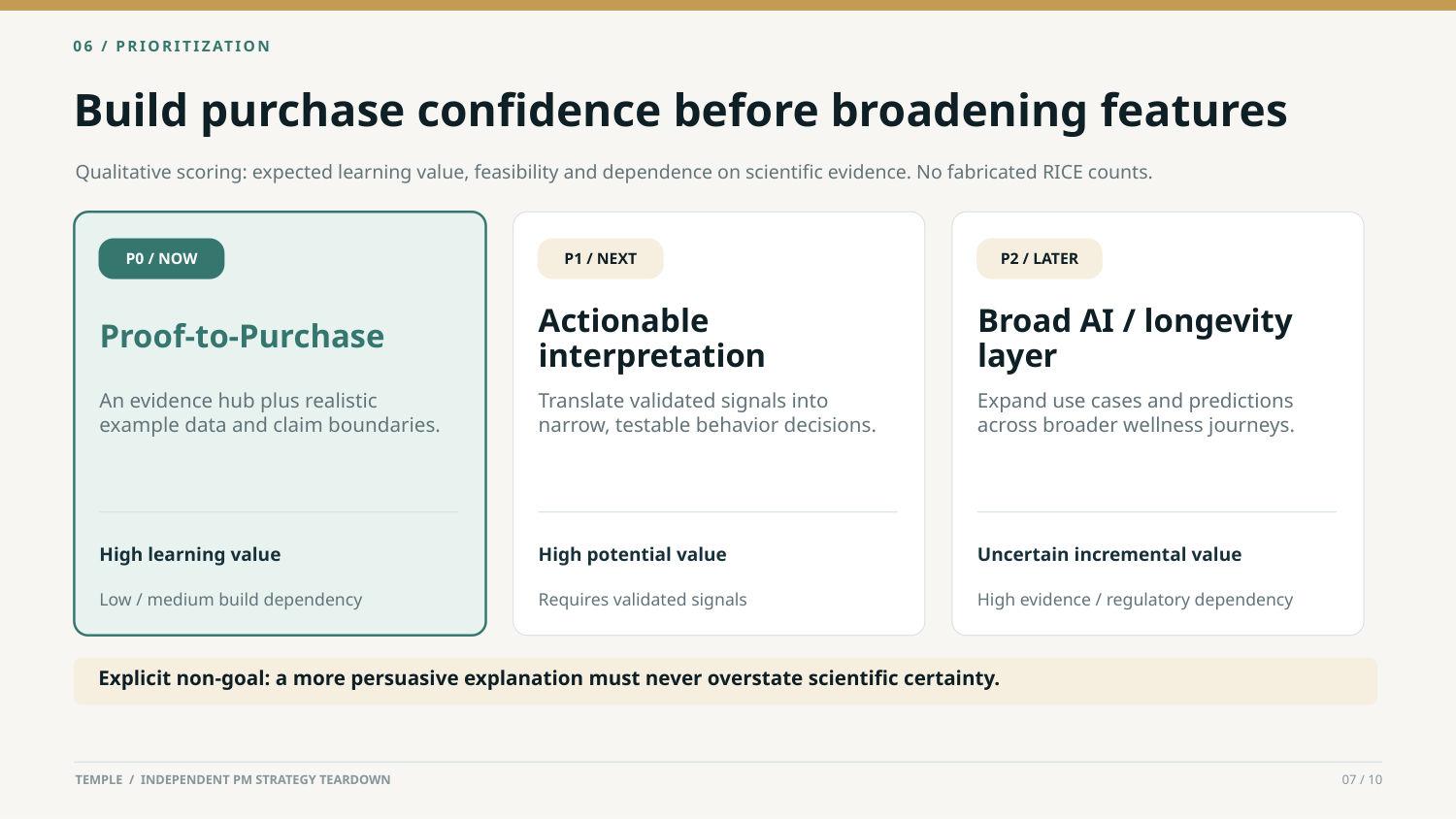
Build purchase confidence before broadening features
ProposalQualitative scoring on learning value, feasibility and dependence on scientific evidence. No invented RICE counts.
Explicit non-goal: a more persuasive explanation must never overstate scientific certainty.
P0 · Now· Selected
Proof-to-Purchase: an evidence hub with realistic example data and claim boundaries. High learning value, low to medium build dependency.
P1 · Next
Actionable interpretation: translate validated signals into narrow, testable behaviour decisions. Requires validated signals.
P2 · Later
A broad AI and longevity layer. Uncertain incremental value, high evidence and regulatory dependency.
Proof-to-Purchase: an evidence-first decision journey
ProposalFive steps: discover the intended metric, examine the study design and its limits, explore labelled example trends, compare against WHOOP and Oura, then decide with explicit expectations.
Designed outcome: not higher conversion at any cost, but informed conversion with fewer misconceptions.
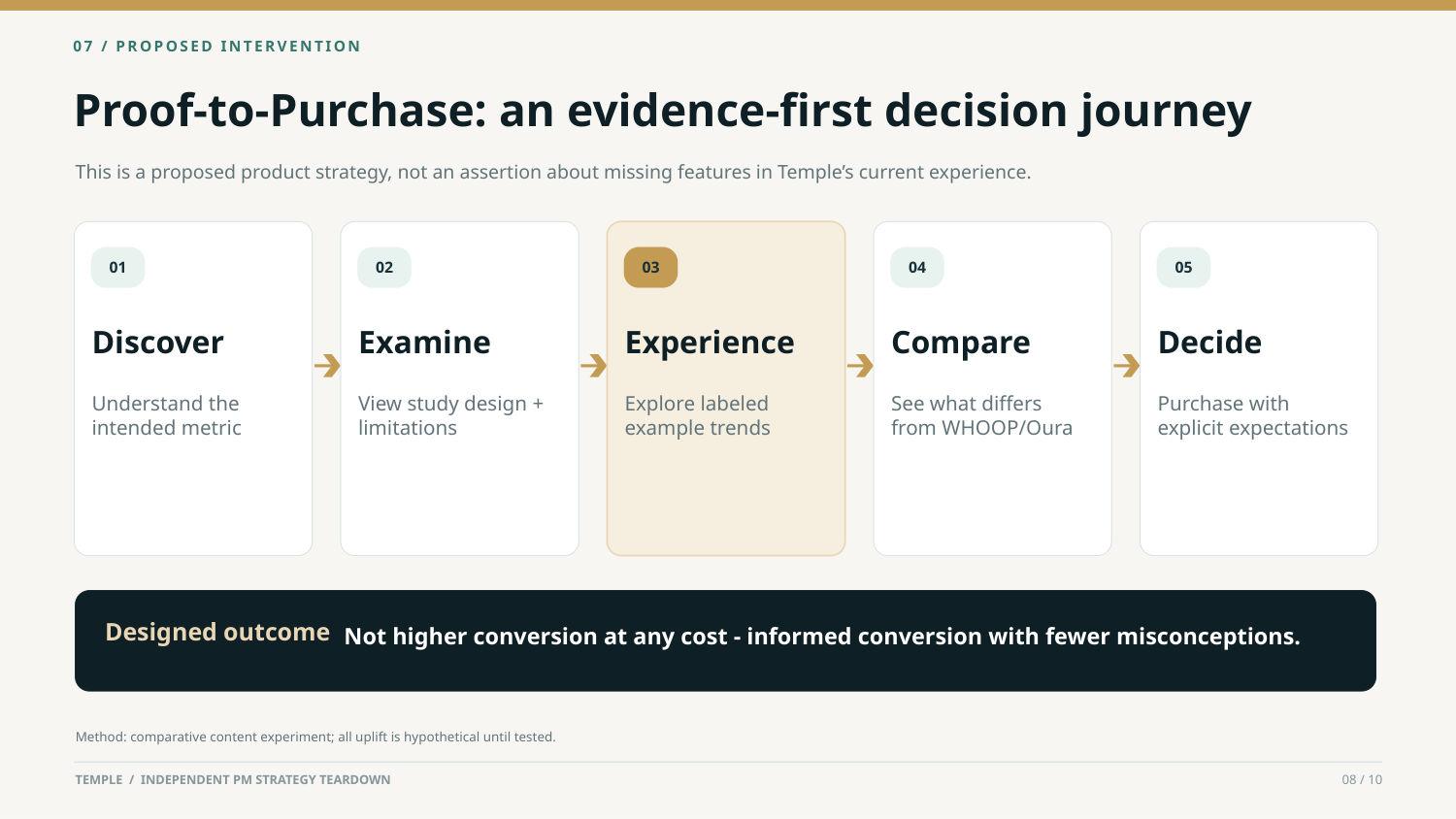
Boundary. All uplift is hypothetical until tested with a comparative content experiment.
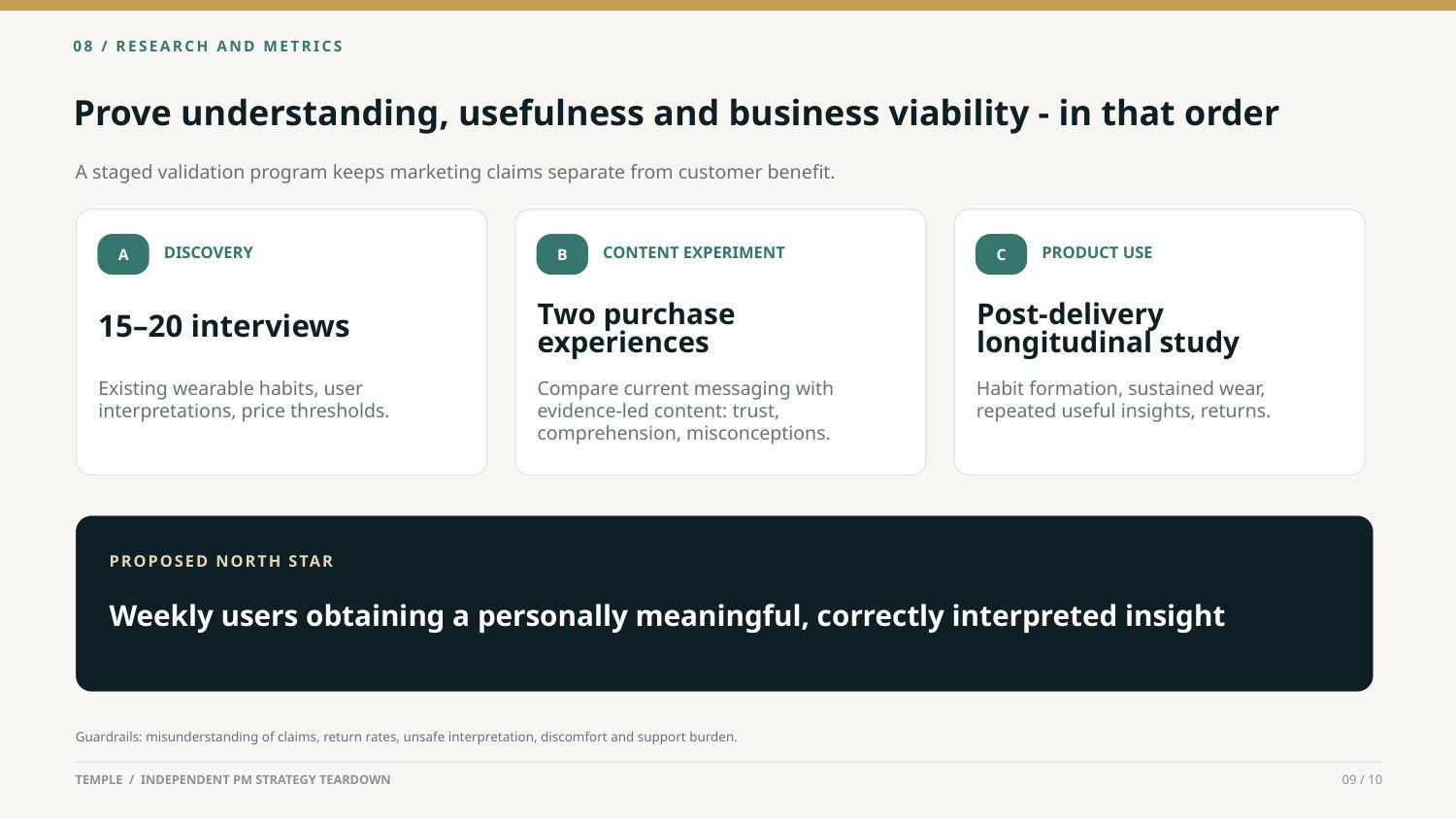
Prove understanding, usefulness and viability, in that order
TargetA · Discovery
15–20 interviews on existing wearable habits, how people interpret the signals and price thresholds.
B · Content experiment
Two purchase experiences compared: current messaging against evidence-led content, measuring trust, comprehension and misconceptions.
C · Product use
A longitudinal post-delivery study of habit formation, sustained wear, repeated useful insights and returns.
- Proposed north star: weekly users obtaining a personally meaningful, correctly interpreted insight.
- Guardrails: misunderstanding of claims, return rates, unsafe interpretation, discomfort and support burden.
Recommendation: defensibility must be earned
ProposalA technically unusual signal becomes a business only when customers trust it, use it and keep paying for its value: measure specific reproducible signals, explain the evidence and its limits, enable a decision users can defend, and give a repeatable reason to wear it.
PM call: validate practical value with expert early adopters before scaling the category.
Boundary. Segmentation, prioritisation, experiments and metrics are independent PM hypotheses, not company disclosures.
Sources
- Temple official product page and Terms of Use (9 Nov 2026)
- Reuters (11 Nov 2026), Moneycontrol (10 Nov 2026), Indian Express (13 Nov 2026), NDTV Profit (1 Nov 2026)
- WHOOP and Oura official pricing